
A controversy about rocks hits Mumbrella
It’s been an interesting time at Mumbrella over the past week as we grapple with a question a little out of our media and marketing comfort zone, involving Aboriginal custodians, vast reserves of natural gas (presumably increasing daily in value at the moment), ancient rock carvings, climate change and cultural power politics.
On Friday the Guardian and Crikey joined the fray, reporting a legal threat and a dropout from our upcoming CommsCon conference. Editorial director Hal Crawford explains what’s going on.
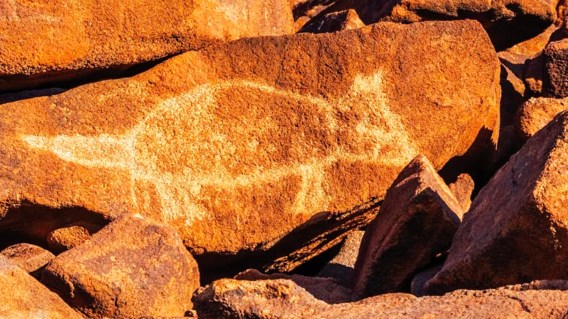
Photograph of a petroglpyh (rock engraving) from the Murujuga National Park brochure (DBCA)
In October last year, Mumbrella called for submissions from the communications and PR industry for sessions at CommsCon, our annual comms conference.
Among the submissions was one that looked intriguing: a presentation from Orizontas and the Murujuga Aboriginal Corporation (MAC) on a campaign to counter opposition to a Unesco World Heritage listing for the Murujuga rock art.
Murujuga, in north-west WA, includes the Burrup Peninsula. It’s right next to the resources hub of Karratha, and it’s home to an ancient collection of rock art. The earliest engravings are believed to be tens of thousands of years old. This antiquity is almost beyond imagining: some of the images, made by the ancestors of the local Indigenous people, record animals long since extinct.
The Burrup is also home to industry: including salt farms, a fertiliser plant, and a gas plant. The latter is part of the enormous North West Shelf gas project operated by Woodside.

This headline is ridiculous, demeaning and completely diminishes the issue. This is not about ‘rocks’. It is an issue of cultural heritage and the big corporations who continue to disrespect and work to erase 50,000 years of history. It is about the power lobbyists have over the Australian Government. I don’t think it’s a coincidence that Orizontas was founded by a former Minerals Council lobbyist… What an utterly disrespectful headline. Shame on you.
This isn’t just a poor headline. It’s a credibility problem.
Calling this “rocks” isn’t a throwaway line — it sets the frame for everything that follows, and in doing so trivialises an issue of Indigenous cultural heritage before the reader has even begun. That’s not a slip. That’s editorial judgement.
And it’s hard to square that with a publication that positions itself at the centre of the communications industry.
If you can’t recognise how language shapes meaning — especially on an issue like this — then what exactly are we learning from you about communications?
This is precisely the kind of framing failure we spend our careers advising clients to avoid.
At a minimum, this deserves acknowledgment. In reality, it warrants an apology.
Because when the industry’s own publication gets something this fundamental wrong, it doesn’t just weaken the article — it undermines trust in the platform itself.
Let’s leave aside the gratuitous CommsCon ticket sell at the end of this piece… why should Save Our Songlines only have right of reply if they can make it relevant to the communications industry? It’s not their job to help Mumbrella build their conference.
Surely they are entitled to the standard right of reply, regardless (especially when as a grassroots First Nations organisation they might not have the same communications infrastructure that Orizontas and co has…)
Hi WTF – I believe Save Our Songlines will be able to get their point of view across and share an experience that may be valuable to our specialist audience at the same time.
Maybe next time instead of just clarifying the science of rocks with an independent source you could make another phone call and clarify the nuance of Indigenous culture? Might have avoided the whole “comfort zone” ickiness.