
‘A massively reduced role for marketing’: Peter Wilkinson on the brave new comms world
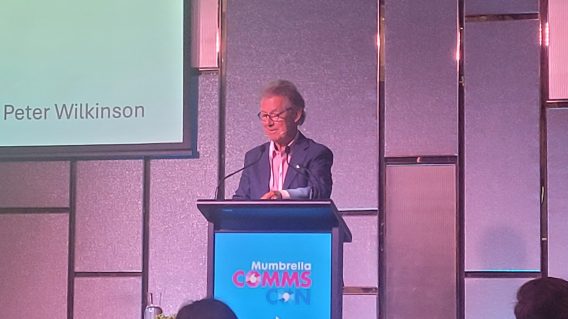
Communications crisis expert Peter Wilkinson has opened Mumbrella’s 2026 CommsCon conference in Sydney by fortelling a massively reduced role for marketing in the new world.

In a provocative opening presentation, Wilkinson argued that — because of AI — the role of corporate affairs and reputation management will soon matter a lot more to companies than marketing and advertising.

“The leader of the 2030 company won’t be marketing, advertising or research. It will be corporate affairs,” he declared to a packed room of communications professionals.

Wilkinson’s main argument was that in a world where journalism is driven by traffic and not truth, and where advertising claims can easily be debunked by AI, a company’s ability to foresee reputational risk and act becomes the defining factor in success. To help illustrate his point, he noted a number of corporate communications nightmares he believes could have been avoided with this new structure.

“The core of my argument is what is for sale is trust. We still all have to sell, of course, that’s not going anywhere … but the pathway to sales is shifting.”

Wilkinson said that AI is already being used by the lay person to research, for example, the cheapest phone bills plus other factors like reliability and green credentials. All this is being delivered to the researcher without marketing spin.

“It’s not about the brand. It’s not about the TV ad. So at Optus, ‘yes’ means nothing to me. The failure of the triple-0 emergency that led to three or four deaths does. A call system that has a rude person or an unintelligible one, those matter enormously. And that’s where corporate affairs is the fixer. That is why corporate affairs is the dominant skill, I believe.

“The corporate affairs at Optus, if it had been working properly: assessing risks and correcting it and getting the governance right, I believe the triple-0 crisis may not have occurred.

“Good corporate affairs practice gives us good governance, good policies, good knowledge of risk, strong culture, good ethics, good behaviour, real news, not fake news, all of which build reputation and trust, which ultimately sells products.”

Wilkinson believes the common argument that AI won’t replace skills like empathy is incorrect — that a machine trained on the lived experiences of billions of humans will have a much better chance of empathising with someone whose entire family was killed in a warzone, or a centenarian entering a nursing home for the first time.

“I can’t walk in their shoes. But if I need to have a close and intimate, empathetic conversation, AI can guide me. It can guide me where the communication trigger points are because it’s harvested hundreds, possibly thousands of people in that particular situation.

“AI is going to guide us on almost everything except one human skill, I believe. Personal relationships, and that’s trust. I think trust is going to be everything and we all are going to have to be focused on it.”

Wilkinson said in the near future he believes “there will be a massively reduced role for marketing”.

He explained: “There’s nothing an advertisement or tactless influencer can do to beat AI when it comes to your choice of vitamins, your choice of telephone company, or your choice of bank.”

Wilkinson listed off three more communications crises that threatened to detonate the goodwill of major companies: the PWC conflict of interest debacle where they gave confidential tax office training to clients, Nine’s sexual harassment and workplace bullying fall-out, and the tobacco industry knowingly hiding the deadly effects of its product.

“Now, I can easily argue that each of those might not have occurred in the AI world.” He believes each of those issues occurred, simply, because the companies became too focused on sales.

“Too focused on revenue, on the next quarter. The marketing imperative crowded out the governance and risk-avoidance imperative. Marketing can get organisations into trouble. Truth, transparency, and trust gets us out of it.

“And my belief is that in an AI world, there is way less room left for marketing. We must all be in the trust business. That’s how we survive the AI revolution.

“Every person — whether you’re in marketing, advertising, consumer, publicity, journalism, corporate affairs — your ultimate currency is trust.

“I think for all of us, the issue is not whether the shift is happening, but whether we are positioning ourselves to surf the wave with it, or be left behind.”

Get the latest media and marketing industry news (and views) direct to your inbox.

Sign up to the free Mumbrella newsletter now.

"*" indicates required fields


SUBSCRIBE

Sign up to our free daily update to get the latest in media and marketing.