
AI vs humans: Choosing sides
In this Best Of The Week (BotW) column, publisher Tim Burrowes lays out the reasons for Mumbrella’s humans-only writing policy. To get Best Of The Week delivered to your inbox every Saturday morning, subscribe to Mumbrella’s daily newsletter.
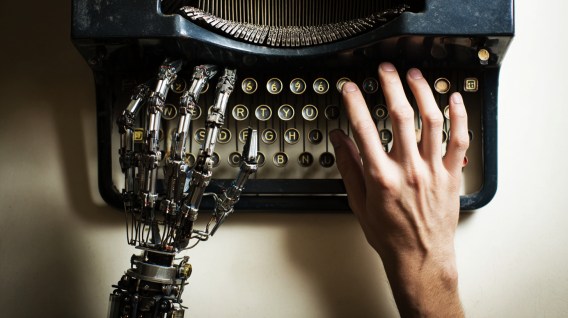
Yes, this image was generated by AI -- the humans-only policy only applies to our writing (Midjourney)
During my long summer break, which you may recall I wrote about in the last BotW, I was (as I often am) plagued by doubt.
This time, it was over AI. During that break, a couple of our competitors talked about how they were now using AI as part of their journalism.
Vinyl Group, owner of Mediaweek, boasted in its January 20 ASX update that it has “incorporated some new AI publishing tools directly into workflows, and the company is on track to 10x content output.”
The same day, Mi3’s newly promoted publisher Nadia Cameron told readers that the masthead’s use of AI to rewrite press releases as news stories (accompanied by haikus) will be accelerated. Or as she more delicately put it: “We’ve made the decision to integrate our two-year-old standalone transactional news service with our core Mi3 masthead content offering and newsletter services.”

You say transactional, I say press release.
Cameron’s observation – “trade publications can’t stand still if they’re to continue to remain relevant and timely, nor can we survive and thrive if we don’t embrace new ways of working to deliver our offering” felt rather more authentic than the claim from Vinyl’s Josh Simons of “clear evidence of the profitability of our unique business model given sufficient scale.”
The key word from Cameron was “survive”. And the qualifier doing the heavy lifting for Simons was “given sufficient scale”.
You can understand why they’re trying to do something different.
This week KK Press – publisher of Cosmopolitan Australia and T: Australia, the local edition of NewYork Times Style Magazine – went into liquidation. Also this week, Signal News said they were exiting the Tasmanian market. A week before that, Business News Australia fell over.
In the US this week, the Washington Post cut 30 per cent of its workforce including 300 journalists.
There may never have been a tougher time for publishing. Even compared to the Fairfax and News Corp bloodbaths of 2012. On Monday, Standard Media Index revealed December numbers showing agency spend was down by 29.2% for the magazine sector in both print and online, and down by 7% for news publishing.
Yesterday’s quarterly update from News Corp didn’t break out their Australian numbers (they stopped doing that two quarters ago, as the news got worse), but did reveal a “lower contribution” locally. That’s despite paid subscriber numbers increasing again.
The pain is being felt more widely across the media sector. It’s not a coincidence that ASX investors have sold Ooh Media down to its lowest point in more than a year, and close to a five-year low.
The trend across the Unmade Index points to a double whammy. Many of the current market capitalisations on the Unmade Index suggest investor sentiment is more irrationally against these media companies than advertising movements alone justify.
The valuation of the combined Southern Cross Austereo – Seven West Media operation is remarkably low. A company that last year made a combined profit of $230m has a market cap of less than $300m. Factoring in net debt of $354m, that’s still an enterprise value of only $654m. That creates two options: Either the market is wrong, and the management will be able to grind out years of managing the business for cashflow and profit. Or it will be crushed by the weight of Seven’s AFL rights obligations and go under altogether.
Arguably Quadrant was ahead of its time when it took QMS off the ASX in 2019. Several of the unloved Unmade Index stocks might do better by being taken private to be refloated when the mood turns.
Overly negative investor sentiment aside, the trend away from the traditional local players is continuing into 2026.
Talk to local media owners, and they express suspicions about what’s happening behind the scenes to incentivise the global agency holdcos to continue to shift their spend to the platforms. Talk to the local representatives of the holdcos and they say they wish they could spend more, if only the local players made it easier.
Both may be true.
Which brings me back to that self doubt. In this publishing environment could Mumbrella’s approach – for human writing being one of the key things that differentiates us from AI-driven content – be the wrong, too costly strategy? In the long term, I still don’t think so. But we’ll see.
This week was one in which the battle lines were drawn, as the debate on the pages of Mumbrella about the ethics and abilities of generative AI began to gain nuance. The humans wrote beautifully.
On Monday, writer Brooke Hemphill explained why she had stopped letting ChatGPT anywhere near her work. She quoted writer Audrey Knox, who questioned what writers get out of saving time with ChatGPT. What activity would they then get to spend more time doing? “The dishes?” Knox asks. “Scrolling social media? Drinking? What the fuck are you talking about?”
Later in the week, Mark Ritson celebrated a piece of AI brand work after a baffling period in which the platforms’ worst software labelling instincts came to the fore. “OpenAI becomes ChatGPT becomes GPT-4 becomes Canvas becomes whatever Sam Altman dreamed up last Tuesday. Google kills Bard, resurrects it as Gemini, then pretends nothing happened. Anthropic launches Claude 3, then 3.5, then sprinkles in Opus and Sonnet variants like a sommelier who can’t commit to a grape.”
Still, the memorable, funny work Ritson was discussing – in which Anthropic promised that its Claude chatbot wouldn’t follow OpenAI into advertising territory – does mark a moment where the AI brands begin to raise their marketing game.
The next day, along came Pip Bingemann, founder of Springboards. OpenAI was also the target. Springboards took an ad spot from OpenAI and recreated it, to point to the fact that the AIs are converging on matters of taste and output. He asks: “If the tools we’re using to generate ideas are all trained on the same corpus, optimised for similar outputs and rewarding safe, predictable thinking – how do we avoid becoming indistinguishable from each other?”
At least some of the answer lies with leaning into the humans.
And yet another angle came from News Corp’s global CEO Robert Thomson yesterday. An under-appreciated aspect of Thomson is the Dr Seuss-inspired monologues he unleashes during investor updates. Nobody loves alliteration as much as Thomson.
News Corp is riding a couple of horses when it comes to AI – defending its content from the scraping monsters, while licensing it to OpenAI, the very people who are driving the output convergence.
“AI is retrospective and synthesises generic content, sometimes imperfectly, but is past tense, often past imperfect,” said Thomson. “We have contemporary creative proprietary content, which is only accessed if AI companies pay us — our ‘woo or sue’ strategy. We’ve been consciously building a moat, and it is a moat with saltwater crocodiles, with sharks, and an even more dangerous species — lawyers.”
“More importantly, the moat separates commodity content from our premium prescient IP.”
I hope he’s right about the moat being the human IP.