
Karl Stefanovic isn’t launching a podcast, he’s building a media asset
Dan Hunjas, founder and director, Edge Marketing, explains how Karl Stefanovic is leveraging decades of media experience and a deep understanding of what audiences want to ride the changing nature of the attention economy with his new venture.
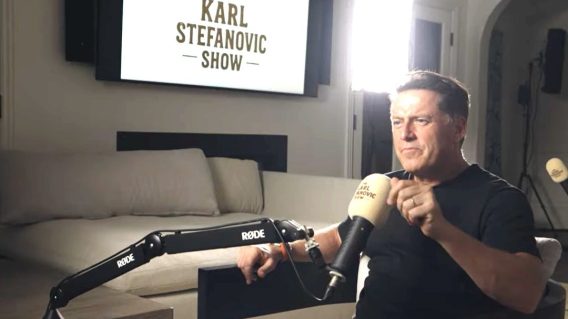
Most podcasts launch cautiously with a lineup of safe guests, agreeable conversations, and minimal risk. They feel like radio without constraints and television without production values.
That’s not what Karl Stefanovic did when he launched his new podcast over the weekend.
His first podcast was a 53-minute interview with One Nation leader Pauline Hanson. Within two days of launch, the episode had been watched over 140,000 times on Youtube alone.

His second episode, released on Tuesday, was with guest Alexander Volkanovski.
That sequence isn’t accidental, it’s about positioning and intent, and marketers should be watching closely. Stevanovic’s move isn’t about podcasting, it’s about where advertising effectiveness is heading.
Pauline Hanson has never lacked media attention but it’s fair to say, in the past, she has lacked uninterrupted, agenda-light conversation. Most media interviews are framed to provoke, corner, or extract a headline resulting in a predictable outcome which audiences can feel.
Stefanovic went the other way, with no visible bias or quest for a viral moment, just an investment of time, curiosity, and a genuine attempt to understand the person behind the politics.
You didn’t have to agree with Hanson to keep listening — in fact, disagreement became irrelevant – what mattered was that the discussion felt real. And that’s the part many media agencies and brands still don’t fully grasp. It’s not that audiences are rejecting hard conversations, they’re rejecting manufactured ones. When people sense authenticity, they stay and when they stay, attention compounds. And where attention goes, money flows.
From an advertising standpoint, podcasts don’t win because they’re novel or cheap, they win because they concentrate attention in a way very few media channels can, and operate in an environment where trust already exists — because trust is what makes advertising work without brute force.
By opening with a conversation that avoided both outrage and pandering, Stefanovic positioned his podcast as an independent environment, a foundation of long-term monetisation.
The model isn’t new. Joe Rogan didn’t build the world’s most valuable podcast by chasing controversy or consensus, he built it by letting conversations breathe, building an audience that trusted the environment first, and monetising once that attention was undeniable.
The lesson for brands is build the audience first — but revenue should always be a close second.
Stefanovic’s scheduling of Volkanovski as his second guest is not a change in direction, it’s confirmation of his strategy. Moving from one of Australia’s most polarising political figures to one of the nation’s most respected sporting champions shows range without chaos, signalling that this platform isn’t ideological, reactionary, or niche but broad, curious, and controlled.
For advertisers, this is the moment a podcast stops feeling speculative and start being worth investing in. It demonstrates that the audience isn’t there for shock value, but for the host and the environment he’s creating.
That’s when attention stops spiking and starts compounding. And compounding attention is what turns media into a serious commercial asset.
The obvious advantage is Stefanovic’s existing profile and his understanding of what makes a good interview and interviewer.
He understands pacing and knows when silence does more work than posing another question — and he respects the intelligence of the listener. These are broadcast instincts developed over decades, and they translate exceptionally well to long-form audio, like podcasts.
Podcasts that fail are the ones where the host confuses airtime with insight, and urgency with value. So far, Stefanovic hasn’t make this mistake and if he resists the temptation to turn his podcast into simply being television with microphones, he won’t just build a popular podcast, he’ll build a trusted platform.
And trusted platforms are where advertising dollars settle long-term.
Brand marketers should be watching closely, as this isn’t really about podcasting, it’s about where advertising effectiveness is heading. The future is fewer environments where people give sustained, voluntary attention, and when that happens, advertising stops being interruptive and starts being additive.
Stefanovic’s opening moves show a clear understanding of that reality. If he stays this course, this will become the most commercially powerful media asset of his career, and potentially one of the most influential independent platforms Australia has produced.
Not because it’s provocative, but because it’s disciplined, credible, and built with intent and trust.
In advertising, that combination always wins.

Karl seems to be going where others fear to tread.. ATM anyway.
I actually think this is a good thing.
It may be early days, but there does appear to have been a seismic change in the political & societal winds in the last few months. If Karl can tap into the apparent widespread distrust (putting it very mildly) of legacy media and bring out his inner Joe Rogan, unshackled from corporate agendas and biases, I suspect he may do quite well.
It will be interesting to see if he is approached by one of the local media streaming platforms. Though I suspect he’s better off staying well away from them if he wants to remain ‘unshackled’.
Impressive start with 140k in two days,
Just interested as to having an idea of how they ‘define’ the 140k in 2 days. Is that the accumulation of the 2 days … like 70k on each day (or 80k and 60k). Any idea of ‘duplication’ of listening (i.e. listen twice on the launch day}.