
Nine’s new world: Less ads, more subs and plenty of AI
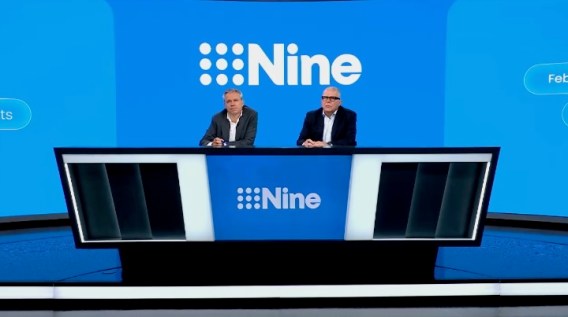
Matt Stanton and Martyn Roberts
Nine’s half yearly financial results show a business undergoing a seismic shift, with total TV revenue down, subscription revenue up and fierce ongoing cost cutting. There was also the tantalising hint of AI licensing deals providing future revenue streams.
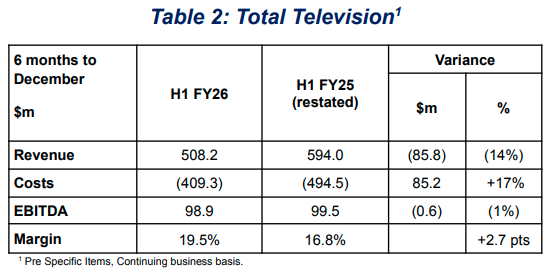
The business posted an EBITDA increase of 6% year-on-year for the second half of 2025. Total TV revenue (free-to-air and on-demand) was down 14%, on the back of the poor ad market and in comparison to a period that included the Olympics the year before. That dragged down group revenue (-5%).
Nine CEO Matt Stanton said the ad market declined 10% in the same period, and described Total TV’s performance as “pleasingly robust”. He rejected a suggestion BVOD platform 9 Now was struggling, saying he was “very pleased with the outlook”.

The big picture for Nine is one of big change, with the announced acquisition of out-of-home giant QMS and the divestment of Domain, Nine Radio and its regional TV outfits. While Domain numbers were removed from the results, radio and the regionals were still included in the H1 numbers.
On the publishing side of the business (the newspaper mastheads including the SMH, Age and AFR), digital subscription revenue grew 17% YOY. Within the division, this strong performance was offset by ad decline, leaving the whole more or less flat (revenue down 2%, EBITDA down 1%).

Stanton said the strong growth in subs revenue had mostly been driven by increased average revenue per user (ARPU) rather than subscriber growth.
“It’s quite a considered pricing and volume approach that we go through,” he said. “The majority of the growth came through ARPU … we also think about the paywall, how much do we open the paywall and close the paywall.”
A new revenue line for Publishing will be content licensing for AI large language models, with Nine’s ASX release noting the “licensing of Nine’s content to other Australian corporations for use in their in-house proprietary LLMs”.

Matt Stanton on the call
Stanton verified that two deals had been done with more on the table.
“I can’t talk about specifics … we have done a couple of deals,” Stanton said. “It’s a license deal, to train their own models, to be a stronger model for them, it’s got the SMH, The Age and the AFR, we’ve done two at this point. It’s a good revenue stream for the future.”
Stanton said that AI tools were being employed internally at Nine in six separate areas. Google’s Gemini is being used for general productivity, with other uses in areas such as product (for example, text-to-speech for written articles) and content creation.
Through the presentation, Stanton emphasised “premium content” as the future of the company, while saying it was important not to pay too much. Nine’s existing NRL rights — its premium content crown jewels — expire in 2027.
“The NRL rights are great rights to get, we’ll be very disciplined as we look at them, but it has to stack up,” Stanton said. “Premium rights … still are good drivers of commercial outcomes.”
As in past investor calls, Stanton called on the federal government to quickly implement changes to the News Media Bargaining Code (the News Media Incentive) which Nine and other media have already provided feedback on.

In terms of cost-cutting, Nine is targeting $160m of annual savings by the end of FY27 (June 2027). It achieved $43m of that in the half, $32m of which was ongoing savings, and $25m of which came from TV (not including the big spend on the Olympics).
Nine CFO Martyn Roberts said $25m TV savings were mostly content — TV strip shows not bought — and that the savings slated for the second half of the financial year would include a higher proportion of personnel costs.
So……they kept pace with the comparable period last year by taking out costs equal to the amount of revenue that they lost through softer advertising markets.
If anyone remembers, the cost-out was disproportionately focused on the publishing business.
The publishing business looks solid due to “increased ARPU”, translation: consumer price increases.
Both of these things are finite – there are only so many costs you can remove, and only so many times you can increase prices and to a certain level (although it seems like subscription businesses do this every year now), especially if you are removing costs associated with increasing the perceived value associated with that subscription.
In any case, it sounds like they are shaping up for a blood bath, with “the second half of the year….higher proportion of personnel costs” and Gemini being used for “general productivity”.
Not that they can be blamed – if (as is extremely likely) linear TV continues it’s sharp decline especially with larger audiences and ad revenues fall commensurately, it’s going to be a rough decade or so for any legacy media company which isn’t worth being bought out by a streaming giant.