
‘No media visionary’: Kerry Stokes’ legacy is a weakened TV sector
In this opinion piece originally published as his Best Of The Week newsletter, Mumbrella publisher Tim Burrowes reviews the media legacy of Seven West Media’s Kerry Stokes .
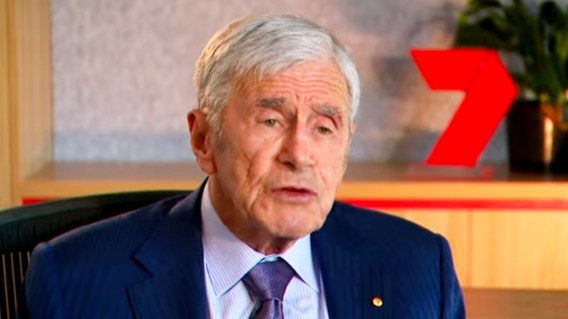
Kerry Stokes (Seven)
On Friday the Kerry Stokes media era fizzled out.
At 4.26pm Southern Cross Austereo dropped an announcement to the ASX slightly earlier than expected — 85-year-old Stokes has stepped down from the board.
Just as all political careers end in failure, the same could be said for media moguls. Very few quit at the top.
Stokes steps down — although his son Ryan remains on the SCA board — with his stake indirectly held through his private company Australian Capital Equity worth just $32m. Last night’s closing price for SCA was $314m. SGH Ltd holds 20.06% of the company, and in turn Stokes owns 50.93% of SGH.

His billionaire status comes from SGH, which is mainly an industrial conglomerate.
Stokes deserves much credit as a self-made man who came from a hard background and built enormous business success. But he was no media visionary.
He was wily in grabbing the media assets he wanted. He crept up the share register of West Australian Newspapers until taking control and merging it with his Seven TV network to create Seven West Media 15 years ago.
But Australia’s TV sector is weaker for having had Stokes at the top table for so long. He waged war against his rivals. The failure of his pay TV service C7 Sport saw Seven unsuccessfully sue Nine, Ten, Fox Sports, Optus, Austar, Telstra, the AFL, NRL and PBL. That put Stokes against both the Packer family and the Murdochs. In 2007 he comprehensively lost the case, one of the most expensive of its time.
When James Warburton defected to run Ten, Seven sued to keep him from starting the job, hobbling the attempt by Lachlan Murdoch to reboot the network.
Stokes funded the failed defamation action of Ben Roberts-Smith against Nine after the former soldier, and later Stokes employee, was accused of war crimes. And while rapist Bruce Lehrmann sued Ten for its allegations, Seven paid his rent for a year.
Actor Craig McLachlan was cleared in 2020 of indecently assaulting his co-stars after reporting by Nine’s newspapers (although the magistrate pointed out that if his actions had occurred after laws changed around an accused’s belief in consent needing to be reasonably held, it could have been a different outcome). Seven paid McLachlan a reported $200,000 to appear on Seven Spotlight.
Stokes used the competitive dynamics in a smart way when it came to sports rights. He used the anti-siphoning laws as a tool by which Foxtel ended up paying for the bulk of the deals, although Seven got more games.
Stokes rejected an invitation to work with direct rival Nine on launching Stan together, instead prioritising his relationship with the Murdochs. The Presto service from Foxtel and Seven was a short-lived technical and marketing disaster.
In the media business, waiting for your enemies’ bodies to float past in the river is sometimes the way to win. Stokes had a few of those moments.
Seven overtook Nine when Kerry Packer fell out with David Leckie, the TV savant who had driven the network. Leckie crossed the street to Seven in 2002. Soon after, Seven’s US studio output deal with ABC came good. Desperate Housewives, Lost and Grey’s Anatomy all came though in a single season taking Seven into a ratings lead in 2005 which it maintained until the industry stopped caring about who was number one in TV.
Stokes hired executives who were good at what they did. A formidable news operation and two decades of winning the breakfast and daytime TV battle speak to that. During Clive Dickens’ short tenure as chief digital officer, Seven was early into the FAST (free ad supported TV) game.
But there was never much vision from Stokes for what was coming next. Stokes hobbled Pacific Magazines’ digital future with the Yahoo7 tie-in (just as Packer did with Ninemsn). During Covid, SWM retreated from magazines, selling PacMags to Bauer Media who proved to be even worse custodians.
Seven made noises about tying up with a subscription streamer – NBCU’s Peacock seemed the likely partner. The launch of free to air channel 7Bravo in 2022 appeared to be a precursor but nothing came of it.
Meanwhile, having briefly come together with Nine, Ten and Foxtel to market the TV medium under the Think TV banner, that has since fizzled out. Freeview is almost invisible. The networks have lost ground to the global platforms be failing to market the medium for the last couple of years now.
And then came the final retreat – merging Seven West Media with SCA. The main assets are legacy – the Seven Network, Triple M, the Hit network and The West newspaper. Streaming service Listnr, 7plus and The Nightly are still only a small part of that whole.
Still, it meant Stokes gets to cleanly walk away from a company that was an increasingly wobbly platform. On Tuesday, new chair Heath Mackay-Cruise will update the ASX for the first time on the state of the merged company. Before the deal, Seven’s net debt was $287m on an annual EBITDA profit of $159m.
Prior to the merger SCA was a well run company in a tough sector. It remains to be seen whether it will be swamped by the Seven culture.
The media was good for Kerry Stokes. He wasn’t good for the media.
Perhaps not everything went Kerry Stokes’ way in the broader media sector, but I thought the summary published in BOTW was unnecessarily harsh.
And I can assure your readers, Dennis Merchant would concur, despite the fact that I can sadly no longer ask him if he agrees with my point of view.
I wish Mr. Stokes continued success in his heavy industrial sector.
Alan Robertson.