
‘Predators in the church’: ACMA slammed in Senate over Kyle and Jackie O
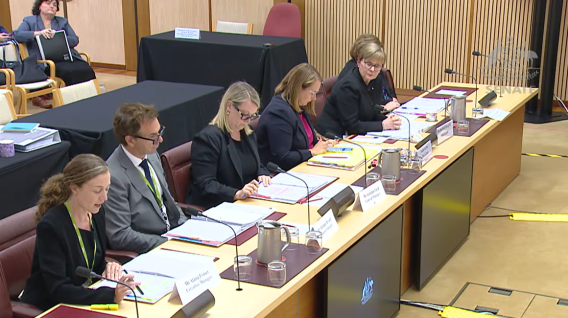
Representatives from the Australian Communications and Media Authority have been raked over the coals during a Senate estimates hearing on Monday afternoon, accused of allowing the organisations it regulates to “sign off on [their own] homework.” ACMA was also berated for allowing the Kyle and Jackie O show to avoid regulation because it moved networks.

The new Commercial Radio Code of Practice was released on the morning of the Senate hearing, and takes effect from July 1. It was developed in consultation with the Commercial Radio and Audio — the body representing the stations under regulation — and features what the CRA referred to in a media release as “substantial enhancements to the existing community safeguards”.

The major changes are a new provision that requires broadcasters to “take special care” during school drop-off and pick-up times (8-9am, and 3-4pm) on school days; and a new AI transparency rule that requires disclosure when a synthetic voice is used during a broadcast.

Despite lobbying from the Australian music industry, no changes were made to the local content quotas.

Greens Senator Sarah Hanson-Young asked if the “special care provision” was about Kyle Sandilands and Jackie ‘O’ Henderson. In November, the watchdog filed a notice of intention to impose a new license condition banning the Kyle and Jackie O show from using strong and explicit sexual references.

ACMA Chair Nerida O’Loughlin danced around the question, calling it “a new provision that CRA volunteered to put in the code after we had raised this”.

She said: “It certainly has been raised in investigations including Kyle and Jackie O but it was a broader consideration by the industry who volunteered to put that in their code.”

ACMA chair Nerida O’Loughlin

Autumn Field, ACMA’s general manager of content division, said the provision was suggested by CRA “in response to community concern that had been raised around a range of programs, including the Kyle and Jackie O program.”

Alana Fraser, executive manager of ACMA’s content safeguards branch, said the provision builds on the existing decency provision, but “nothing changes in terms of how that provision operates”. Fraser said ACMA’s expectations are that “extra consideration” is given to content broadcast during those windows, including additional steps such as “warnings before certain segments”.

Enjoying Mumbrella? Sign up for our free daily newsletter.

Hanson-Young pointed out that Sandilands and Henderson have already breached the existing decency provisions multiple times, and that the “decency provisions weren’t able to stop their vulgar, disgusting, misogynistic, sexist rubbish — but you think this new care provision will?”

O’Loughlin admitted she didn’t expect the new provision to curtail Sandilands and Henderson’s content, but pointed to the notice of intention, filed in November, to place a license condition on ARN’s station licenses for KIIS 1065 in Sydney and KIIS 1011 in Melbourne.

She said the licensees have made “representations to us on those license conditions” (as required under law), and that these representations are “under active consideration at the moment, and we expect to settle the matter in the coming weeks.”

O’Loughlin said one of the possible consequences for breaching these conditions would be “suspension or cancellation of licenses”, but admitted this has never occurred.

ACMA has previously enforced a license condition on the pair’s former station, 2DayFM after a 2009 lie-detector segment where a 14-year-old girl revealed on-air she’d been raped. This condition required the station “to not distress, humiliate or exploit any people under the age of 18.” O’Loughlin noted this during the Senate hearing, adding “but we did not need to proceed any further with that because Mr Sandlands and Ms Henderson moved from that licensee to another license.”

Hanson-Young said this “sounds like predators in the church being moved around, not being held to account”, to which O’Loughlin said “I expect that’s a question for the new licensees as to why they picked up the program.”

In a statement to Mumbrella, ACMA confirmed ARN had made representations on the proposed additional licence conditions.

“The ACMA is considering the licensees’ representations and we will announce the final additional licence conditions once a decision is made. The final conditions will also be gazetted on the Federal Register of Legislation.”

Sarah Hanson-Young unleashed on the ACMA representatives on Monday afternoon

AI disclosure and US interference

ACMA also revealed that the new AI transparency provision was a direct result of ARN’s use of  an entirely AI-generated host “Thy” on Sydney-based CADA station for six months, without disclosure. Again, this condition was at the behest of the CRA.

O’Loughlin revealed the CRA thought “it was timely, given they may use AI, particularly for something like a music program.” She said the CRA though “it was important for their audiences to know that they were using artificial intelligence”.

There are caveats around the level of disclosure. Fraser explained that the provision only applies to “regular programs” which means something that is broadcast, in a repeating schedule, at least once a month. She also said “stations can disclose this on air, in a later episode, on their website, social media, or any other suitable platform.”

When asked why the updated code didn’t strengthen protection rules around Australian music, O’Loughlin said the proposal put it by the Australian Recording Industry Association (ARIA), to shorten the window in which the local content quotas apply from between 6am and midnight to 6am to 6pm, “sat outside the Australian US Free Trade Agreement”.

She explained “they were not things that we felt we could pursue, they would be matters for the government.”

When asked why ACMA felt this was the case, O’Loughlin said its internal legal team advised them on this. She admitted they hadn’t sought advice from foreign affairs and trade, but wrote to the Minister for the Arts and the Minister for Communications “about a week and a half ago” and hadn’t received a reply.

O’Loughlin claimed “there are very particular reservations to do with these time periods in the free trade agreement.”

When asked why ACMA hadn’t sought any independent advice on this, O’Loughlin replied: “I think our advice was very clear.”

ARIA’s response

In a press release issued on Monday afternoon, ARIA CEO Annabelle Herd called the new code of practice “another instance of Australian radio policy failing the country’s homegrown culture and artists in the very market where they should have a natural advantage”.

“Under the current framework, stations are meeting their obligations while relegating Australian music to overnight and off-peak slots. The practical effect is that the quota exists on paper but delivers little for artists or the Australian listeners it was designed to serve.”

Elsewhere during the lively Senate hearing, independent Senator David Pocock grilled ACMA for “watering down” the wording of a press release regarding a Sportsbet breach at the company’s request (as revealed by the ABC), and for delaying the release of news that Commonwealth Bank breached spam laws until after the bank’s AGM, again at the request of the company.

The watchdog also came under fire for delaying the investigation into the Optus outages in September and for admitting it may still share a copy of its draft report with the telco before issuing it publicly.

“We’ve seen the example with CommBank, with Sportsbet, with radio stations, with Optus and Telstra,” Hanson-Young said.

“How many times did this have to be revealed before you thought it wasn’t a good idea to get the companies you regulate to sign off on your homework?”

Get the latest media and marketing industry news (and views) direct to your inbox.

Sign up to the free Mumbrella newsletter now.

"*" indicates required fields


SUBSCRIBE

Sign up to our free daily update to get the latest in media and marketing.