
Six things Australia’s social media ban will not achieve
The government’s social media ban will go into effect next week. Fabulate’s Nathan Powell looks at the implications of the ban both societal and for the industry.
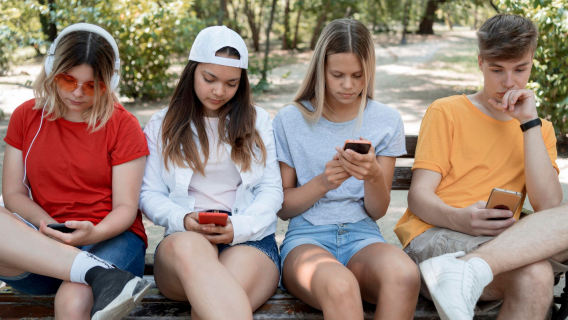
Wholesome teens, enjoying the great outdoors
Australia is once again reaching for its favourite political pressure valve: the sweeping ban. This time it is social media.
With next week’s decision to block under 16s from platforms like Instagram, Tiktok, Snapchat and even Youtube is being framed as a bold act of protection. A safeguard. A moral stand. The latest installment in the never ending quest to save young people from… well, being young people.
Cue the classic Simpsons line: “Won’t someone please think of the children?”

Kids are addicted to their tech.
No doubt about it.
They scream in class if you tell them to put their phone away, which should be in a pouch, anyway. They throw a fit if you tell them to take their phones to the deputy.
Let me say it again: they are addicted.
They don’t pay any attention to the real world.
They don’t care about their education.
Their handwriting looks like it is written by a 5 year old.
Their social skills are next to dead.
Their attention span is out the window.
They can’t spell because they use spell-checkers for everything.
Now, 90% of this is due to the department all but stopping the use of workbooks.
I don’t deny that.
But I try my hardest to at least give them worksheets to do with a pen.
They are addicted to their tech.
I could go on, but I am in class right now, trying to give a music lesson, but all they’re doing is hiding their laptops on their laps looking at social media.
Kids are addicted to their tech, and nobody can tell a childhood professional otherwise.
Now, blame the government, blame the department: blame whoever you want.
No matter who is to blame, the kids need to get off their tech.
It is not a ban, it is a minimum age similar to other unhealthy things like alcohol and cigarettes.
Don’t be captured by the tech bros whose only KPI is to keep the kids on screen for the maximum amount of time.
Hey Nathan, good to hear from you. Buddy, I gotta push back on some of this, having dived deeply into it.
Let’s do them one by one:
1. You say: “There is a fantasy that removing teens from Instagram, TikTok, Snapchat and YouTube will somehow send them joyfully skipping back to linear TV, radio and newspapers. This misunderstands how our culture now works.”
I say: This was never the intent of the eSafety Commissioner or the law. The intent was to start the process of protecting kids by delaying the use of social media until kids are 16.
It’s the same logic as 18 for alcohol, etc. I’m not sure that anyone thinks kids under 16 are emotionally strong enough nor skilled enough to navigate addictive algos created half a world away for profit. Nor should they. That’s the law’s job.
2. You say: “Bullying is awful. Full stop. It should not exist anywhere. But banning social media will not make bullying disappear.”
I say: No-one is saying it will, but the law is saying it will help.
You draw the line that there is bullying in the playground too. There is, but schools often remove bullies from school for that reason. That doesn’t end bullying. Full stop. But it does disrupt it. This law is the same.
If another bully/abusive app turns up, let’s expel that one too. The law has tools explicitly for that.
3. You say: “If the concern is harmful content, then banning social platforms is inconsistent to the point of absurdity. Teens will still be bombarded with gambling ads during every major sporting event, betting odds integrated into live commentary, programmatic gambling placements across the internet – the list goes on.”
I say: Great. I agree. Let’s ban that too. It means we have made the world a better place twice. BTW, you’d know better than me, but how many gambling ads does Meta show to kids in Australia per day?
4: You say: “It will not reduce screen time. Every credible study shows the same pattern. When you remove one digital outlet, behaviour does not decline. It redistributes.
“Technology is now woven into everything young people do: how they communicate, learn, socialise, relax, complete homework, explore interests and navigate the world.
“And here is the uncomfortable truth: A ban does not make teens less online. It makes them more motivated to go deeper. To find workarounds, VPNs, hidden apps, private browsers, offshore platforms and unregulated spaces adults never see.”
I say: This is law is not about reducing screen time, it’s about removing young impressionable eyes from tox unvetted content.
But let’s break down your points one by one.
First, it is likely to reduce screen time, because schools and parents will feel empowered to take phones away. It’s a tough power balance between kids and parents – this edges it more towards safety.
Tech is woven into kids’ lives, but perhaps it shouldn’t be so much for under 16s? That’s core to the issue here. Is unfiltered digital access the right life for a child too young to drive?
And kids can “communicate, learn, socialise, relax, complete homework, explore interests and navigate the world” without Insta.
And when you say the ban (it’s a delay, not a ban – just a delay until they turn 16) will motivate them to find workarounds and dark, scary alternatives, etc…
Well, I’m covering case after case around the world about social harms, and dead kids, and Meta’s pretty dark, buddy. Whistleblowers are coming out of the woodwork every week.
The trial coming up next year when 31 states sue Meta has some ugly evidence in the bundle.
Finally, you cannot choose to not pass a law because some people will choose to break that law. What you do is pass the law to protect the majority, and pass penalties to police those who break it. That’s justice. Let’s call it social justice.
5: You say: “It will not prepare young people for the future digital economy. Blocking teens from Instagram, TikTok, YouTube and Snapchat restricts them from the modern classroom.”
I say: It’s not a block, it’s a delay, and YouTube Kids and educational video is excluded.
And if Meta and Snap were a classroom, it would be a very different experience. They don’t exactly make an effort to educate kids do they?
They are advertising monopolies that use social media apps to sell attention. They make their money selling ads. Of Meta’s US$164.5 billion in revenue, 97.2% came from ads – so what do you think it’s most focused on?
Here’s the test: If the government passed a law banning education on Meta, do you think it would have cared?
The reason they’re rattled is because half the world is looking on to see how this turns out. By delaying kids, it’s reducing ad load – and the world has a lot of kid they monetise.
So, Australia should hold its head high for putting the welfare of young kids ahead of the profits of tax-dodging monopolies.
Meta paid less than 1% tax on its Australian earnings last year, funnelling unknown revenue due to a refusal to report them (ACCC estimates ~$5 billion) through offshore accounts in Ireland. Very social.
6. You say: “It will not make teachers’ or parents’ jobs easier. Parents already struggle to understand the digital ecosystems their children live in. You cannot supervise what you cannot see.”
I say: I wouldn’t presume to speak for all parents as you have, there is too much nuance in 20 million loungerooms.
But for every parent who finds this hard, others will find life easier. Doing nothing means nothing changes and the benefit – of whatever size – is lost.
No-one thinks this social media delay will be a single-shot fix. This is day one of a new future where an unpoliced, illegal, immoral monopoly has to take more care of Australians.
And let me justify those four: Unpoliced. Illegal. Immoral, and Monopoly.
Unpoliced: Meta claims it is covered by Section 230, meaning it can republish anything it chooses without sanction. That means it is unpoliced.
Illegal: Section 230 is a US law, which has no jurisdiction in Australia, or anywhere outside the US. Meta therefore breaks Australian law on copyright, decency, contempt, defamation and more hundreds of millions of times a day. Worth noting too the US is only 4% of the global population.
Immoral: By deciding it’s not responsible for the content it publishes to 96% of its audience that live outside the US – and selling ads on all of it – Meta explicitly puts profit before people. That’s immoral.
And monopoly: OK, I’ll give you that one. It won its antitrust trial and was not deemed an illegal monopoly, unlike Google which was three times over.
That’s a shame but three out of four ain’t bad.
Why don’t we let the law have a go at making Australia a safer place for under-16s. Let’s reduce our phone use, dump toxic social, and hug our kids a little tighter tonight. That’s the future I’m focused on.
A lot of your assumptions here are that the government won’t change more laws to crack down on any loopholes or workarounds dont be so sure about that. The moment some kid gets preyed on because a parent allowed their child access on purpose there will be more onus placed on the parent to use family accounts with parental controls also where exactly is a 12 year old going to get a vpn from anyway? Don’t parents watch their kids at all anymore? I dont think you fully understand the online risks happening at the moment and how bad its gotten with trafficking rings, suicide groups, sextortion, blackmail etc
The Snapchat attempt at complying with the new law is a joke…. they are using Face ID to verify if a user is over 16 or not.
A. how can that possibly work when there’s such wild variation in how 13, 14 and 15 year old kids look.
B. My 13yr old son came home laughing yesterday. One kid in his class looks older and got past the Face ID check. So the whole class got that kid to do their Face ID’s and low and behold all are now ‘verified’.
Great work Snapchat.
Damn well put Nathan!
To the NSW high school teacher…well said.
If any parent says that there shouldn’t be a ban, maybe they could ‘lend’ their own phone to their child to use for social media if they feel their child is hard done by. How about that. Happy kid/happy parent.
Im sorry, but anyone who thinks this is a good idea is desperately out of touch with reality…. It takes about 30 minutes to make a new website these days I can have ChatGPT work me up a new social media network in about 10 minutes buying the domain on GoDaddy will cost a couple of dollars and hosting it on Amazon web services maybe a few hundred dollars at most. And hey Presto! You have a new social media network. One that will take months (if not years knowing the government) to clock onto and then add to the list by the time that happens there would’ve been a plethora of other social media networks up-and-coming to fill the void. This ban is another government overreach. And a violation of the children’s constitutional right information and communication and the , baby boomer hobbits under the hill in Canberra are delusional if they believe they can out tech gen Alpha and that this ban will somehow magically be the first ban that actually works and doesn’t just spawn new problems in other places. Why not make the social media companies have stricter algorithms for content moderating? Why why not introduce laws with stricter punishments for cyber bullying which would punish the actual perpetrators and not an entire generation? The many instances where a blanket ban has failed miserably serve as evidence of prohibition policy failure. Guns? (You can still print & purchase guns in Australia- except those selling them are organised crime groups) drugs (drugs are more widely available in Australia today than they have ever been in ever increasing volume, variety and value – the war on drugs has been fought, and lost…) , vapes – can still buy vapes anywhere you could before the ‘ban’, even the excessive tax on cigarettes and liquor apart from unfairly targeting lower income earners all its done is create a profitable black market for tobacco and encouraged home brewing/distilling of alcohol.
And at the end of the day just like the stupid ban on vapes all this ban will achieve is wasting the precious little time the politicians actually are at work andnhave the chance to discuss meaningful, worthwhile legislation.
Our government is full of idiots who decide their own salary and have zero accountability and zero idea what being an ‘everyday Australian’ is actually like
It’s incredibly difficult to not see through the agenda behind this opinion piece. It’s just further proof that the marcomms industry can’t get behind a world-first attempt at saving kids from the 24/7 dopamine drip and self comparison machine that evolution has not equipped the human brain for. Doing zero 0️⃣ ent working, so why not try this and see what impact it’ll have. It can’t be worse.