
The Malinauskas comms lesson: Start with values
Crisis communications expert Peter Wilkinson examines SA premier Peter Malinauskas’ stunning election victory at the weekend, and finds a comms philosophy finely tuned to appeal to the Australian character.
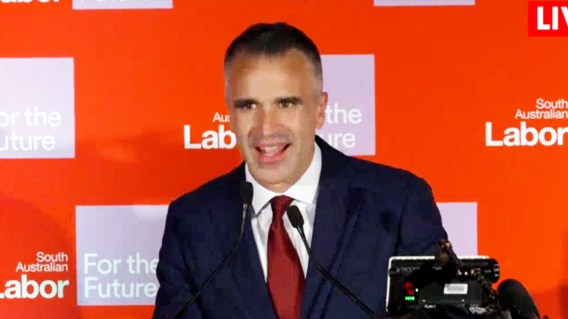
Peter Malinauskas (Seven)
The South Australian election shows how leaders can use communication to draw people in rather than turn them against one another.
The thundering victory of Peter Malinauskas and the Labor Party in the South Australian election has foundations in an economic and general competence of government.
But what intersected with voters as they prepared to vote was the way ‘Mali’ communicates, and the message he was conveying.
Leading into the South Australian election, the incumbent premier managed to craft a message that steered away from too many specific issues, and dealt mainly with himself as a person, his values and a desirable and recognisable Aussie culture.

His novel acceptance speech, including a poem, on Saturday night spoke to the same.
He said, in part (starting around13 minutes into the speech):
“To my colleagues: Although this is a historic result, although it is the best result our party has ever achieved, it’s very important that no one confuses tonight’s result as adulation. Instead, we should see it as only being an invitation, an invitation to continue to work our guts out for the next four years.”
Why was it such a great piece of communication?
In client media training, we talk about three sets of messages which can broadly be classified as:
- The incident message – the issue right in front of us;
- The company message – the guiding philosophy of the organisation;
- The personal message – the defining beliefs and behaviours that define the leader, including, in this case, bravely, but effectively, a Henry Lawson poem, “The Duty of Australians” (see below for full poem).
In the Malinauskas speech he hit all three, but it was his personal message that hit home. Good leaders, in defining their own philosophy, draw in followers who see an aspirational set of values.
For Malinauskas that’s hard work, unity in diversity, care, and compassion. And a love of all that is Aussie. It’s how a lot of us like to see ourselves, regardless of background.
It reminds me of the Pew Research results published earlier this month in which Australians rated our morals and ethics highly, compared to 24 other nations.
As well, he’s pragmatically set himself against the left of his own party. This is evidenced by his nuanced position on nuclear energy, and being one of the few Australian public figures to take a stance on the Adelaide Writer’s Week controversy and the disinvitation of Palestine activist Randa Abdel-Fattah.
It’s in these values that South Australians get to see themselves.

The author Peter Wilkinson
Another, and a big message in the Malinauskas speech, was humility: the clever use of “we” instead of “I”, and avoiding self-congratulation (“we should see it as only an invitation …”)
The Malinauskas ability to project the best of our Aussie-ness – and ask voters to see themselves in that vision – plays into this ready acceptance of ourselves.
It’s also a clever repudiation of some of the negative messaging that we have grown used to in politics. The Donald Trump way of communicating might have a patriotic flavour, but it also excludes and bullies. Nigel Farage’s Reform Party in the UK and Pauline Hanson’s One Nation both have a negative focus on people who feel left out of the economy and the political conversation.
A positive mirror
If we look at the emphatic Labor-Malinauskas result in South Australia, I think we see a communication style and content that not only expresses a personal suite of values, but asks voters to see themselves in these attributes.
I’ve often wondered if a leader who communicates a strong principle-led vision influences people’s attitudes about each other.
What we do know is that when a leader is overtly driven by a belief in “what is right”, Australians will give that person breathing room on the tactical front, and excuse them for making mistakes. Think Bob Hawke and John Howard.
When a leader’s behaviour is underpinned by a personal philosophy, the voters can see a pattern of behaviour that matches the speeches and announcements.
The Malinauskas win in South Australia isn’t just political, it’s a lesson in how to communicate: start with your values and principles, and include people, rather than cut them out.
The Duty of Australians (Henry Lawson, circa 1909)
‘Tis the duty of Australians in the bush and in the town,
To forever praise their country, but to run no other down,
When a man or nation visits in the heyday of its pride,
‘Tis the duty of Australians to be kind but dignified.
‘Tis our duty to the stranger landed maybe but an hour,
To give all the information and assistance in our power,
To give audience to the new chum and to let the old chums wait,
Lest his memory be embittered by his first days in the state.
‘Tis our duty when he’s foreign and his English very young,
To find out and take him somewhere where he’ll hear his native tongue,
To give him our last spare moment and our pleasure to defer,
He’ll be father of Australians as our foreign fathers were.
Peter Wilkinson is chair of Wilkinson Butler and a crisis communications expert.
By choosing the Lawson poem, with its message of acceptance of ‘new’ Australians ( i.e. immigrants) it was a strong repudiation of One Nation’s nasty, negative message. I hope that was not lost on people although it seems to have been lost on journalists and commentators.