
Why junk food ad bans won’t fix Australia’s obesity problem
Last week, Mumbrella ran an opinion piece calling for a federal UK-style junk food ad ban. Here, Australian Association of National Advertisers CEO Josh Faulks argues that such a ban would be ineffective and “strip hundreds of millions of dollars from media and sponsorship ecosystems.”
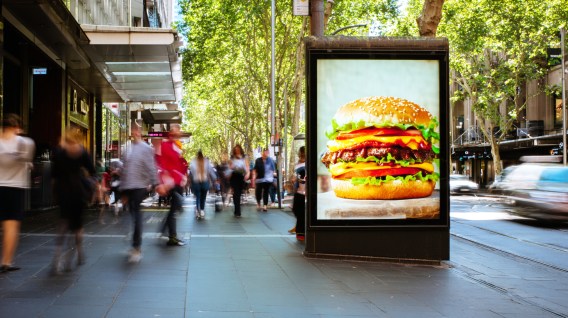
"Obesity is a complex, multi-factor challenge. There is no single lever that will solve it." (Midjourney)
Every few years, a familiar policy reflex returns: ban advertising and hope the problem goes away.
The UK has now pushed ahead with new restrictions on food and beverage advertising, framed as a decisive blow against childhood obesity. Predictably, the question is already being asked here: why hasn’t Australia followed suit?
The short answer is simple — because the evidence simply does not support it.
Advertising bans have not reduced obesity anywhere they have been introduced around the world. Not in the UK, not in Quebec, not in Chile. In some cases, obesity rates actually increased after the bans were introduced. That’s not ideology, it’s data.

Yeah, nah.
Firstly, junk food isn’t just about obesity, it’s linked to heart disease, cancer, the list goes on. Bad diets are one of our biggest killers. Framing this as about obesity is deceptive.
Secondly, advertising bans do work. And here are the facts.
Tobacco advertising bans: “…lead to reductions in the numbers of people that start and continue to smoke. Statistics also illustrate that banning tobacco advertising and sponsorship is one of the most cost-effective ways to reduce tobacco demand.” https://www.who.int/europe/health-topics/tobacco/banning-tobacco-advertising-sponsorship-and-promotion#tab=tab_1
Restrictions for junk food advertising on Transport for London (TfL) networks have prevented almost 100,000 obesity cases and are expected to save the NHS over £200 million. https://link.springer.com/article/10.1186/s12966-022-01331-y
No actual data to support any of your claims (other than a link to the AANA’s own research), likewise, a complete misinterpretation of the actual ban in place in the UK (where brand advertising is still permitted, just not specific product or offer-led messaging).
And whilst I agree that there are many factors that contribute to obesity in children (and indeed the broader population), that you conveniently choose to ignore the many well documented and proven societal benefits witnessed as a result of the smoking advertising ban speaks volumes.
It’s not just advertising. But advertising is a start.
No one says “ban advertising and hope the problem goes away”. Ban advertising for harmful food and beverages, and be part of the solution. How about that, Australian Association of National Advertisers?
And what does your reference to “complaints to Ad Standards” have to do with this issue? Absolutely nothing. You’re distracting the reader.
You’re probably the first organisation to claim that advertising drives sales. Yet you seem to believe that “obesity rates increase after advertising bans are introduced” – hmm, must have been the ban on junk food advertising that did that.
There is no single lever. You’re quite right here. But advertising is one of them, and that is YOUR responsibility.
The largest casualty of any ban would be tech platforms
Grassroots sport would be the least impacted.
This is a poor argument poorly constructed.