
AFL ratings: Game on for the most expensive sport in Australia
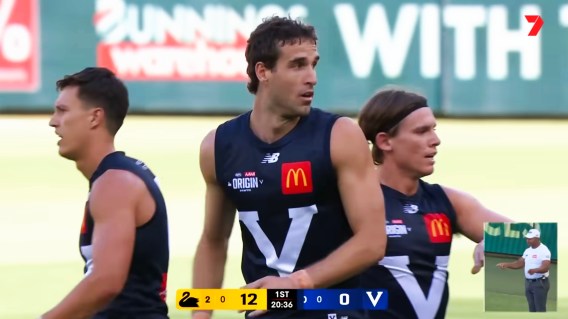
Ben King (centre) having kicked a goal in the Victoria-WA Origin match (Seven)
With the AFL season launching Thursday March 5, the rights holders are facing an uphill ratings battle to recoup the massive sums they have shelled out.
For Seven and Foxtel (and digital rights holder Telstra), the cost to show the most expensive sport in Australia amounts to $643m each season until the end of 2031 – an upgrade on the $473m per season under the terms of the former two-year deal that ended after the 2024 season.
The broadcasters have committed to an eye-watering $4.5b in total for the deal which is now entering its second year.
Since the current AFL rights deal was agreed, the key signatories have fled the TV landscape. News Corp and Telstra sold most of Foxtel to Dazn, while Kerry Stokes and now Jeff Howard have bailed out at Seven, leaving SCA’s John Kelly and Heith Mackay-Cruise to face the challenge of paying the AFL rights invoices.

So what does ratings success look like for the broadcasters?
Maintaining existing ad revenues linked to the AFL for both broadcasters is the starting position. To do that they need to maintain existing ratings and make some noise about them. For Seven that means more games pushing above 700,000 people for its Friday nights and closer to that for its Thursday and Sunday clashes.
At Foxtel, it means keeping the set-top-box audience of 200,000, maybe another 150,000+ on Kayo and sharing some of the those ratings publicly with the market. Continually pushing for more subscribers to both Kayo and Foxtel is obviously key too. Lifting the price of Kayo in 4K is not going to help.
AFL ratings: Where is the bar set?
In the ever-changing world of TV ratings, a look at how Seven and Foxtel fared in 2025 will show the level they need to reach in 2026 to offer advertisers a similar audience.
Seven’s five most-watched matches last year were finals, and coincidentally the only five times the broadcaster averaged over 1m viewers (average audience, broadcast plus BVOD).
Those games were:
- Qualifying Final Collingwood v Adelaide 1.105m (Thursday)
- Semi Final Adelaide v Hawthorn 1.004m (Friday)
- Preliminary Final Geelong v Hawthorn 1.313m (Friday)
- Preliminary Final Collingwood v Brisbane Lions 1.552m (Saturday)
- Grand Final Geelong v Brisbane 4.186m (Saturday)
In the regular Home and Away season, Friday night continues to get a big tick from viewers with four of Seven’s five biggest Home and Away round audiences on that night. Those four matches all had an audience over 700,000.
However, the biggest Home and Away audience on Seven in 2025 was 875,000 for the King’s Birthday Collingwood versus Melbourne clash which saw Collingwood get home by just a point.
The best from Foxtel’s 200+ games
The first year of the new TV deal saw Fox Footy calling every game with its own announcers for the first time.
Foxtel hasn’t yet integrated Kayo audiences for all agencies accessing Kantar data, but it will be available in a matter of weeks. The Kayo numbers can more than double the total Foxtel group audience for some events.
The biggest games on Fox Footy watched via Foxtel set top boxes see over 200,000 people watching. This happened more than 20 times last year, around 10% of the total matches covered.
The biggest matches on Foxtel were the final series. All of the games (and remembering Foxtel doesn’t screen the Grand Final) were over 200,000, with the two biggest crowds of the year watching the preliminary finals (each one was over 300,000).
Broadcasters get more for their money
The $643m the rights holders spend this year gets them a little extra. Seven and Fox Footy both broadcast the recent State of Origin clash between Western Australia and Victoria.
The mid-February game saw an average audience of 843,000 watching on Seven and 7plus. A number that Seven noted was up 34% on the 2025 full season average. Seven also confirmed the day after the match that the Origin fixture will return next year.
The AFL Origin numbers are well short of the showcase that three Origin matches are for the NRL where Nine has exclusivity. The 2025 Origin decider on Nine (Game 3) had an average audience of 3.9m.
Later this year broadcasters also get a bonus with the addition of the Wildcard Round. This effectively means there will be a 10 team final series after the Home and Away games are completed.
Also new this year are Friday night AFL double headers on six evenings. Unlike the NRL Friday night games, the AFL doesn’t schedule early and late games to allow fans to watch both games.
Seven’s AFL team

Seven’s 2025 AFL Grand Final on-air team: Nick Riewoldt Kane Cornes Rebecca Maddern Brian Taylor Luke Hodge Mitch Cleary
There have been minor changes to the Seven commentary team for 2026, and a programming tweak too.
The broadcaster has welcomed back Collingwood 425-game veteran Scott Pendlebury for special comments on a number of matches during the year.
Also joining the commentary team is former Hawthorn star, former Nine Footy Show regular and House of Wellness host, Shane Crawford.
Seven’s team calling the matches is Brian Taylor, James Brayshaw, Hamish McLachlan and Alister Nicholson. Expert commentary will come via Kane Cornes, Luke Hodge, Abbey Holmes, Nick Riewoldt, Matthew Richardson, Daisy Pearce, Dale Thomas, Joel Selwood, Kate McCarthy, Erin Phillips, Chad Wingard, Cameron Ling, Jobe Watson, Campbell Brown and Jude Bolton.
Missing from any commentary this year will be Jason Bennett who worked on both AFL and VFL matches for Seven across the past 11 years.
In a classy exit from the broadcaster, Bennett posted on his socials last week: “Since I was 4 years old, my dream has been to call footy on Channel 7. Realising that dream over the past 11 years has been a great thrill, and I’m so thankful to the legion of people on both sides of the camera who made it happen and supported me along the way.
“But nothing lasts forever. I may pop up here and there to call some footy and other sports this season, with a view to returning to more regular calling in 2027 should an opportunity arise.”
A significant programming change sees Seven adding a third night of its midweek AFL program The Agenda Setters on Wednesdays. The extra episode will initially be hosted by Craig Hutchison in addition to his Monday hosting role with recent Nine poaching Tom Morris expected to take over when his Nine non-compete expires.
Seven is also screening AFL documentaries on former commentator Dennis Cometti and a number of club focused docuseries after last year’s Full Sweat looked at Hawthorn.
New signing only change at Fox Footy

Fox Footy’s team wearing their club colours except for the execs in suits – Fox Footy’s Mick Neill, Fox Sports’ Steve Crawley, AFL’s Andrew Dillon and Foxtel Groups’ new recruit from the AFL, head of corporate affairs and comms Brian Walsh
There seems to be only one significant change at Fox Footy on Foxtel and Kayo with former Adelaide coach Ken Hinkley joining the massive commentary team.
Hinkley will join the army of commentators and hosts as they call every AFL game for the second successive year. That team includes Jonathan Brown, Garry Lyon, Sarah Jones, Gerard Whateley, Nathan Buckley, Adam Simpson, Matt Hill, Shaun Burgoyne, Ruby Schleicher, Anthony Hudson, Eddie Betts, Kath Loughnan, Alastair Lynch, David King, Mark Ricciuto, Cameron Mooney, Leigh Montagna, Jason Dunstall, Mark Howard, Gerard Healy, Kelli Underwood, Jack Riewoldt, Will Schofield, Nick Dal Santo, Dwayne Russell, Jordan Lewis, Jess Webster, Corbin Middlemas, Adam Papalia, Brad Johnson and Ben Dixon.
Increasing his time on air via Friday Night Footy will be 2025 signing, former Geelong player Tom Hawkins.