
Five more Kyle questions answered: Would ARN have to pay a lump sum?

Last week, lawyer Michael Byrnes answered five questions on Mumbrella’s mind after reading Kyle’s initial open letter. Today, he weighs in on the legal arguments and potential financial implications for ARN revealed in Sandilands’ court documents.
Yesterday, Mumbrella published the full text of Kyle Sandilands‘ “Concise Statement” in his lawsuit against ARN in the Federal Court.

The statement argues that ARN’s termination of Sandilands’ contract was invalid, and that Sandilands, through his company Quasar, is still owed all entitlements under his 10-year agreement.

We had some questions, and turned to media contract lawyer Michael Byrnes. Byrnes is an experienced workplace relations lawyer and partner at Swaab, with extensive experience in media and talent.

Michael Byrnes

At its core, does Kyle’s legal attack boil down to: “I didn’t breach the contract, and even if there was an issue, ARN made it impossible to remedy, then demanded I fix it”?

First, the primary claim is that Kyle did not engage in the “serious misconduct” which formed the basis of ARN’s termination of his services agreement. The exchange with Jackie O on 20 February 2026 was said to be congruent with the style, tone and nature of the show (which is said to be “high energy and controversial”, including content that was “irreverent and deliberately provocative, including crude humour, ribald commentary and sexual innuendo) and the “robust character” that ARN desired from Kyle, specifically the role of the “…dominant and abrasive personality who was deliberately outrageous and often offensive”.

Second, the “serious and imminent injury” said to be occasioned to the business of ARN, being Jackie O’s refusal to continue to work with Kyle, could not be remedied by the time the notice to remedy was served on Kyle because, by then, ARN had already terminated Jackie’s contract.

It seems Kyle wants the full value of the contract, not just damages. Does that mean he will be willing to follow through and work for this organisation despite all that’s happened? Does that ever happen or is it just a ploy?

The concise statement seeks specific performance of the contract. It is predicated on the basis that the “purported termination was invalid and of no effect”. A declaration is sought in these precise terms. It is not a “ploy”, and every indication Kyle has given is that he is ready and willing to perform the obligations under the services agreement.

That said, this is still, fundamentally, a case about damages, with the starting point for damages being the balance of the sums that would have been payable for the remainder of the term of the contract (stated to be $85 million).

If ARN are in fact required to pay out the contract, would that then normally be paid out in a lump sum, or would it become due over the course of the original contract? Any big lump payment would cause ARN significant financial pain. 

It would ordinarily be payable as a lump sum in the event of a judgment against ARN. Damages are subject to principles such as mitigation, so it is unlikely to be the full $85 million even if Kyle is successful.

It would, nevertheless, be a substantial sum for which, presumably, some provision will need to be made by ARN if an assessment is made, and there is some risk of it suffering an adverse outcome.

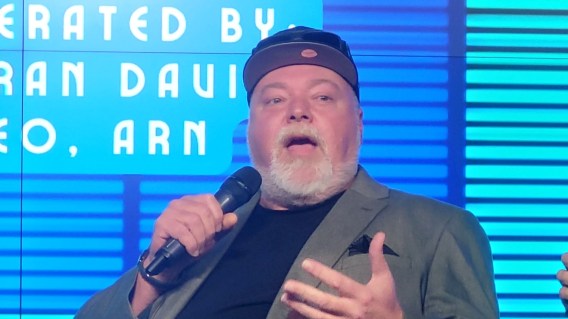
Kyle Sandilands and Jackie O Henderson with Ciaran Davis

How much weight do you put on the fact that various personnel at ARN, including management, allowed the segment in question to go to air (without dumping)? Is it relevant that the segment was then excised from the podcast?

The concise statement emphasises the role of the censors, essentially submitting that if the censors permit his content to go to air (which the exchange on 20 February did) then Kyle can’t be held responsible, and it cannot then constitute serious misconduct for the purpose of the services agreement. It raises the question of whether there could have been a disconnect between the role of the censors as they may have understood it (to prevent further broadcast regulation breaches) and the extent to which the services agreement protected Kyle in relation to any contentious content that happened to be broadcast because the censors did not stop it as they did think it gave rise to a broadcast standards issue (even if it might have been potentially problematic in other ways, as happened on 20 February).

While, as a practical matter, it might have been difficult for ARN management to remove Kyle from the air as the exchange was unfolding, as noted in the concise statement, he continued to present the show after the date of the exchange (20 February) until the date of his suspension. That does seem inconsistent with a subsequent assertion he had engaged in “serious misconduct”.

The financial structure of Kyle’s contract is laid bare in the filing, with five separate line items, including “IP sub-licence fees”. Is there anything unusual or notable to you about these arrangements?

While the contract was clearly lucrative, and there are a few interesting quirks (like the flights and free advertising), there was nothing particularly unorthodox or unusual about the structuring. Service agreement structures, including IP licence agreements, are common for top-level media talent.

Get the latest media and marketing industry news (and views) direct to your inbox.

Sign up to the free Mumbrella newsletter now.

"*" indicates required fields


SUBSCRIBE

Sign up to our free daily update to get the latest in media and marketing.