
‘Next to no chance’: Gambling ad reforms sink chances of a record NRL broadcast deal
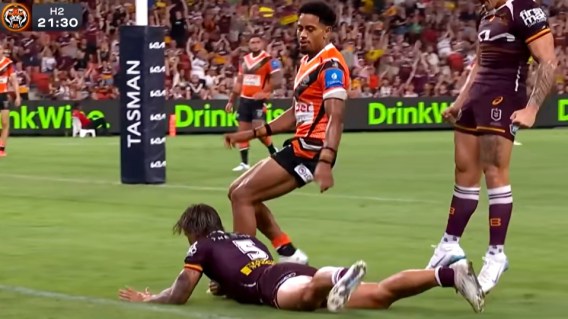
Gambling advertising reforms may have ended the NRL's chances of a record deal
A rights expert says gambling advertising restrictions announced by the Prime Minister last week have shot down any chance of a record broadcast deal for the National Rugby League, as the league’s boss maintains nothing is amiss.
Last Thursday, Anthony Albanese announced a raft of incoming measures, including a limit of three TV ads per hour for betting agencies, restrictions on cross-promotional gambling content during commentary, and a ban on in-stadium and jersey advertising.
There are also requirements in the TV code of practice that already restrict gambling advertising or promotion of odds during live sports broadcasts between 5.00am and 8.30pm.

Despite – or perhaps because of – this, Peter V’landys, the chairman of the Australian Rugby League Commission, was again beating the drum for a $4 billion, five-year deal over the weekend, telling The Australian he has “no doubt we will have a record deal”.
After “leaking” broadcast data to the masthead that claims a record 25 million viewers have watched the opening four rounds of the 2026 premiership across Nine and Foxtel, V’landys said the broadcast deal for the 2028 season onwards will be done “in the next two to three months”.
“We’re in the best position now that we’ve ever been to get the best broadcast deal.”
Lachlan Gepp, a partner at law firm Hamilton Locke and an expert in gambling and sports media rights, disagrees with this sentiment.
He believes the NRL has “next to no chance” of topping the AFL’s record $3.5b, seven-year deal in the current market, predicting the league’s next broadcast deal will be “significantly less” than what the AFL snared from Seven and Foxtel.
“The next [NRL] broadcasting deal was already facing stiff challenges due to a soft television advertising market and lack of genuine competitive tension in the buyer pool,” he tells Mumbrella.
The gambling advertising reforms announced last week “have thrown another spanner in the works”, he said, as the league attempts to negotiate.
“There’ll be less ad spots for the broadcasters to sell, meaning there’ll be less advertising revenue coming into the broadcasters. Any dollar that is lost from gambling advertising revenue to the broadcasters will ultimately be worn by the codes, because their media rights deals will be worth less.
“I can’t see the NRL getting close to the current AFL broadcast deal in terms of annual value.”
Gepp has spent his career working on major media rights deals involving professional sports and racing bodies, wagering companies, and TV networks.
Despite V’landys claiming “every streamer and every broadcaster” is interested in securing the NRL, Gepp feels the actual bidding pool is a lot smaller.
“I think they’re dreaming in relation to any offshore streaming platforms like Amazon or Netflix. There’s just no chance that they’ll be serious players.”
He says these platforms tend to invest in documentaries around sports — such as Netflix’s successful Drive To Survive series around the personal lives of Formula 1 drivers — or tentpole events, like the NFL’s Christmas Day game, rather than weekly sporting fixtures.
“The NRL is going to be back in the market with the same usual players in the box seat, being Nine on the free-to-air and Dazn/Foxtel on the subscription — despite what they say.
“I think the buyers, being the media companies, know that. And so I think they’ll be quite aggressive with their positions in relation to value and standing their ground a fair bit. There’s no real third-party, non-traditional broadcast competition that’s legit. I just don’t think that’s the case.”
Despite the weakened bargaining position of the NRL, Gepp doesn’t believe the money will go backwards from the current deal, signed in late 2021, and worth between $340m-$400m a year.
“I think the NRL has grown significantly as a product since the last deal, and it’s a growing competition with more content too, with two teams coming in. The number will go up, but I don’t think they’ll get close to the AFL deal on an annual basis — for reasons totally out of their control.”
Gepp says the AFL’s current broadcast deal with Seven and Foxtel was “remarkably well-timed” for the league. The contract was signed at the end of 2022, when there was still a lot of money in the advertising market, and public interest in football was high after the pandemic.
“There was still a lot of positivity in terms of the gambling advertising market, and gambling companies were still quite flexible with their advertising in television broadcasts.”
Fast-forward to the current climate, and there’s volatility in the market, with fewer advertising dollars, and the acceptance that the gambling money will eventually dry up completely.
Gepp said NRL executives “might even be considering a short-term rollover with existing partners” and renegotiating in a few years “when macroeconomic conditions have stabilised or improved”.
He said V’Landys will be under pressure to finalise the deal before the end of the calendar year.
“It was already going to be a really hard deal to do. The NRL was already up against it, in terms of trying to get a bigger deal than the AFL, which V’Landys is on the record saying he wants.”
There’s also the unpredictability around the nature of the legislation.
“We don’t know when all these details are going to come in. We don’t know if there’s going to be any phased approach to the implementation. All of that uncertainty just adds to the complexity of doing the deal,” Gepp added.


Really??? That claim???
“After “leaking” broadcast data to the masthead that claims a record 25 million viewers have watched the opening four rounds of the 2026 premiership across Nine and Foxtel…”
Australia’s population is around 28m. Yet the claim is of “25 million viewers have watched the opening four rounds …”.
If 25m viewers HAVE WATCHED THE OPENING FOUR ROUNDS … roughly nine out of ten watched the four rounds. At that rate the FIFTH ROUND would increase to about 31m viewers … impossible.
There may have been 25 million views in the four weeks and may have been added to generate the mis-understood ‘ebullient’ claim.
Sensible measurement would be a ‘per week’ total of the 9 games per round.
Also, consider that most important if you are looking for the number of the ads seen and their duration … that you need an estimate or measurement for how long in the 40-minute halves et.al. were viewed. That would provide a more likely ‘viewing duration’.