
Radio industry promises unified audio exchange, presses the case for bigger spend
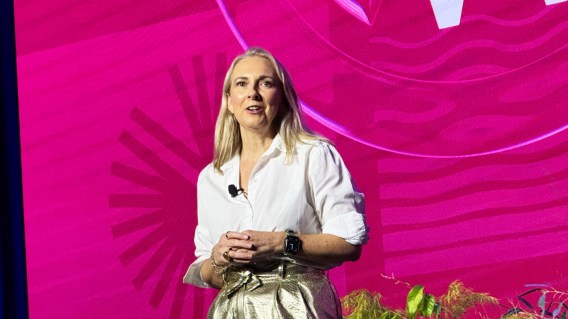
The commercial radio industry presented a united front to advertisers and media at its annual Heard conference in Sydney on Tuesday afternoon, announcing a “unified audio exchange” to be launched next year.

Commercial Radio and Audio CEO Lizzie Young opened proceedings by touting the appeal of audio (read: radio and podcasts) to consumers.

Young cited a Deloitte report that found news consumption is down 26%, social has declined 16%, video is back 13%, while audio consumption has risen 33% year-on-year — now commanding 28% of total digital entertainment consumption.

“In Australia, it is the only medium with significant growth,” Young said. “This is a cultural shift, and it’s happening because audio is built for how people actually want to engage: present, purposeful, woven into the fabric of real life.”

Young said that commercial radio delivers 12.4m weekly listeners in metro markets — more than commercial TV, BVOD, or ad-supported Spotify — with regional Australia audiences of 5 million. CRA’s own research shows 52% of Australian consume podcasts every month, up 6.8% year-on-year, with 58% of these listeners tuning in several times a week.

“Yet relative to our audience, our revenue continues to underperform,” Young said.

“Don’t get me wrong, our digital revenue is strong and growing circa 20%, but our broadcast revenue isn’t,” she said. “And, given our audience and particularly the stability of our broadcast reach, this doesn’t make sense, especially when you consider the radio outperforms so many other channels at every stage of the purchase funnel and on an ROI basis, it returns $2 for every $1 spent.

“Now to be clear, the fact that our revenue doesn’t match our audience is our problem, not yours, but improving that position is our absolute focus.”

It was certainly the focus of the next 90 minutes, in which lively presentations from the likes of radio presenters Christian O’Connell and Ben Fordham on the emotional impact of radio were cut with on-screen advertisements that hammered the point: namely, that audio advertising overdelivers and is under-utilised so you should all buy audio advertising, stat!

But how much is needed to make it effective? According to Mark Ritson, you will see oversized effects if you allocate at least 11% of your advertising budget towards audio. Ritson reiterated the main points of his presentation at Heard ’24, which — in its favour — proves the data he leans on to make his point is robust enough to stay relevant two years on, despite the shifting nature of the medium.

Ritson readily admitted he doesn’t understand the quantum of radio allocation: “Why does 11% makes such a difference? I don’t know, I have no idea. But it does.”

“Hello fuckers”: Ritson’s affectionate greeting to Heard 2026 (Mumbrella)

In fact, most of the data and arguments made at Heard 26 were familiar. Regional Australia is an untapped market of radio lovers with heavy pockets; demographic and location targeting is coming very soon to CRA’s Audio ID; audio has the power to connect with audiences on an intimate level, thereby piloting them towards the “add to cart” button; sounds are more memorable than visuals. They are all good arguments, but the elephant in the room was video’s encroachment on audio-only podcasts, which wasn’t directly tackled.

Audio ID, the industry’s unified digital audio identifier, is close to entering phase two, CRA promised. It was launched via Google’s Display and Video 360 in November and is “now ready for clients to activate”.

“Our next horizon is a unified audio exchange, one access point, all commercial streaming podcast inventory, consistent products, measurement, and real time activation. And we are in active development now. Working towards bringing this to you next year,” announced Nicole Bence from Nova.

Bence was on stage with Ben Campbell from ARN, Jonathan Mandel from Nine Radio, and Ollie Newton from SCA, physically projecting the industry’s unified front.

Like Lizzie Young, they seemed almost apologetic that commercial audio hadn’t kept pace with the other mediums in regards to delivering what advertisers want from them.

“Ease and accessibility hasn’t always kept pace with other channels,” Newton said. “This feedback from agencies and advertisers has been consistent. You want access to audio’s reach and effectiveness without friction.

“You want targeting, you want measurement. Importantly, you want scale and you want it to be easy. A single point of access to our total audience. To address this, we’ve been building a solution that enables you to access exactly that.”

ARN’s Ben Campbell took the baton.

“We are removing the complexity from audio programmatic buying. Targeting is intuitive, scalable, and efficient. Whether you are targeting women 25 to 54 in Brisbane, or men 18 to 39 in Victoria, or any demographic nationwide, no duplicated reach, no excess frequency, no wasted impressions.”

The unified front shown by the radio networks at Heard stands in comparison to the TV industry, which has talked a lot about collaboration without much action.

Both Nine and Seven claimed they were working together with Ten on a unified ad buying/spruiking system, after the slow collapse of Think TV but nothing more has been said on that front since (and, as we saw it was actually SCA and Seven who were working behind-the-scenes on unifying).

There were two further, particularly salient points made about commercial radio and audio during the presentation. It’s the country’s only 100% Australian owned-and-operated media industry.

Also, despite the radio industry’s insistence on referring to regional Australia as ‘boomtown’, the truth remains that this area represents 37% of the country’s population, yet receives just 18% of Australian media spend.

This is a 19-point gap between where people actually live, and where the advertising is directed.

As Lara Thom, the CMO for Guzman y Gomez, pointed out during an on-stage interview with Young, people in the regions do buy things, too.

Thom was a great saleswoman for the power of audio advertising, and a perfect way to wrap the event, telling a few stories about the public’s fondness for GYG’s sticky “love ya!” audio hook. She also gave a shout out to “Lisa” from Nova who helped kick off one of their most memorable campaigns eight years ago, where people on the street attempt to pronounce the name of the restaurant.

“There’s a real opportunity for brands to experiment around: ‘How do you tell your story? How do you get under the covers? How do you start telling things about your brand?’ and can you do that across radio,” Thom said.

“We’re only limited by our own creative thinking and challenge your teams to think differently or your agencies or whoever it may be, because you never know.

“You might end up still talking about a campaign you developed eight years ago — because it still bloody works.”

Get the latest media and marketing industry news (and views) direct to your inbox.

Sign up to the free Mumbrella newsletter now.

"*" indicates required fields


SUBSCRIBE

Sign up to our free daily update to get the latest in media and marketing.