VFX: Thor
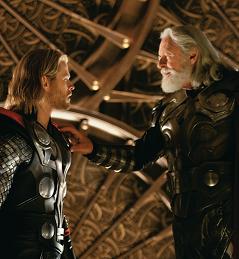 Just like other drama directors before him, Kenneth Branagh faced the challenge of being an industry veteran, yet a novice in the ultra high budget, VFX intensive level of filmmaking. Miguel Gonzalez reports.
Better known for his Shakespearean work on film and on the stage, Kenneth Branagh was an inspired yet unusual choice to direct the film adaptation of the Marvel Comics superhero and god of Thunder, Thor… and he didn’t hesitate when he was approached to helm this project.
“I knew Thor would be an epic on a scale that I had not worked on before, so I was excited and surprised,” admitted Branagh.
He even finds similarities between the work of Shakespeare and the world of Thor – the Norse god of thunder sent to Earth to learn humility: “They’re both about royal families, the tension between the private world of public individuals, and the jobs they have to do. The themes in the film are the kinds of things that Shakespeare was interested in; they’re popular and archetypal.”
Branagh defines the film’s process as a “pretty high-tempered affair from start to finish”: “On these films, it’s a fairly high level of intensity all the way through.”
Pre-production required the definition of the look and feel of the film – a huge task considering the more than 40 years of Thor’s visual history. The cost-intensive shoot was also stressful, because “there are so many variables, and one is prone to ill fortune sometimes, just circumstantially”.
Equally important was the post-production and VFX process: “It’s the department with whom you’re in touch from the very first minute until the very last. They’re constantly asking you about what’s important
to you in a scene, in a frame. Some of the entirely CGI shots need to fit into a pretty strong visual style, and you have to work it out as you go along. You have a massive team of pre-visualisation and postvisualisation
artists and then of course they connect to the dozens of vendors who were providing the shots for us. It’s a huge parallel industry inside a single movie on this scale, and it’s been fascinating to work with them.”
To realise the film’s complex VFX element, the director worked closely with co-producer Victoria Alonso and VFX supervisor Wesley Sewell.
“Literally on day one, they were the first two people I met, to talk about how we would approach things. They took me into pre-visualisation work immediately; they let me play with the toys and the equipment that
previously I’d only read about James Cameron using,” he said.
According to Branagh, working with several VFX vendors was well worth the complications: “It’s quite an enormous logistical exercise to make sure that all stays on song. In the VFX world you just have to be talking with as many people as you can, as often as you can so that everybody knows what the refinements are going forward, and still allowing enough room for creativity and imagination in that process as well.”
The director participated in the selection of vendors, including Australia’s Fuel VFX.