

Absurdity in advertising isn’t such a silly idea
From Old Spice’s teleporting towel-man to Didi’s deranged leprechaun, the ads we remember most are the ones that make the least sense. Laura Agricola, strategy director at Sick Dog Wolf Man, dismantles the myth that logic drives performance, showing why absurdity, when used deliberately, is one of the most powerful attention engines in marketing.
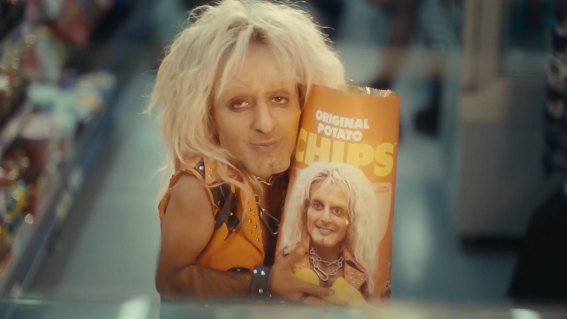
Nudgy, Didi's troubling mascot
What if I told you a drumming gorilla, a man on a horse in a shower, and a creepy leprechaun all had one thing in common, and it’s not micro-dosing mushrooms? It’s absurdity. And it sells.
People notice absurd things. Not because they want to, but because their brains are wired to.
Science (yes, this is the nerdy bit) calls it ‘meaning maintenance’. When reality doesn’t match expectation or social norms, the brain scrambles to close the loop. In marketing, that’s gold dust. It’s the difference between an ad that gently strokes your attention (like most do) and one that grabs it by the neurons and won’t let go.
Most client briefs that land on my desk ask for ideas that build ‘relevance’, ‘awareness’, and ‘engagement’, which, on paper, sounds fine. But let’s break it down for a second. Relevance is about fitting in; Awareness is about standing out; and Engagement is about people stopping what they’re doing and caring enough to act.
Each of those goals runs on a different mechanic: familiarity, disruption, and emotional investment. You can hit all three in one campaign, but only if you’re willing to colour outside of the lines and break something, whether that’s tone, logic, or expectations. But few clients are eager to commit to that level of chaos or embrace the absurdity it brings.
I’ve never seen a client brief where the Think/Feel/Do says the goal is to evoke ‘What is this and why is it happening?’ And yet, that’s precisely what cuts through. The industry’s obsession with sensibility is the very thing the human brain is trained to ignore.
The psychology (and biology) of the absurd
When a social norm or familiar pattern breaks, your brain sprints to catch up. Researchers call it ‘expectancy violation’, which, if I’m honest, sounds like a crime, but it’s how memory works.
Violate expectations with humour, surprise, or nonsense, and people remember. They might even talk about it. That’s exactly what happened when packaged food brand Dolmio launched billboards around London with pasta that looked like sexy, nude body parts, with copy ‘Your pasta’s naked without sauce’. Visuals were engineered to stop commuters in their tracks.

Does this give you that Dolmio grin?
Absurdity doesn’t trigger the fight-or-flight response, but it does hijack the same early-warning systems that were meant to keep us alive and repurposes them to keep us entertained.
Some of the same physical reactions still show up: pupils dilate, dopamine fires, attention spikes. Your brain basically goes, ‘Something’s happening… possibly danger, possibly a naked pasta torso bum’.
Eye-tracking studies prove its impact: people don’t just glance at absurd ads, they linger longer. You know how ‘eyeballs’ is the KPI for awareness? Well, absurdity delivers that, only these eyeballs are high on Ritalin.
What’s even cooler is that absurdity isn’t just a noun. It comes from absurdism, a philosophical worldview shaped by Albert Camus, who described it as the conflict between two things: Our desperate need for clarity, purpose, and sense-making; and the universe’s complete indifference to giving us any of that.
That clash, between meaning-making and meaninglessness, is the absurd. Which means absurd is packed with tension. And in in our line of work, tension is everything.
When absurd becomes iconic
Let’s talk about the classic Old Spice campaign, which features a man in a towel teleporting through logic holes, selling deodorant without ever showing deodorant. It obliterated ROI. Sales were up 60% in the first three months and more than doubled by the end of the same year, well exceeding the goal of 15%.
Another classic, Cadbury’s Gorilla, is a simple 90-second spot with a large gorilla sitting at a drum kit playing along to Phil Collins’ ‘In the Air Tonight’. No chocolate. No message. People couldn’t explain it, so they talked about it. Sales went up 10% during the campaign period.

The Cadbury gorilla
Liquid Death might be the most absurd brand of all time. It’s a simple product (water), reimagined through absurd branding (a beer can), marketed like heavy metal. In 2024, the brand’s valuation had reached US$1.4 billion.
And Didi might be the most joyful and unhinged ad of all time. Here we have a creepy flute-playing leprechaun dude called Nudgey on a surreal night out with three misfits. Ahead of its launch, unbranded footage surfaced on TikTok and Instagram, amassing over 50 million views and speculation.
As I’ve just demonstrated, absurdity isn’t randomness for its own sake. It’s organised chaos, designed to jolt people awake, pull them in, and then resolve into something that makes sense. It’s art. It’s clever. And its effect is simple: instant attention and higher brand recall.
Still not convinced? Here’s a more quantitative argument for losing the plot.
People are exposed to more than 1,000 advertisements each day, according to an analysis from Fennis and Stroebe. A survey by Oracle (with more than 12,000 consumers and business leaders) found that only 20% of brands use humour in offline ads, and even less, 18%, use it in online ads. And research from Kantar noted that the proportion of ads using humour globally has dropped from 53% to 34% since 2000 despite its proven effectiveness. Which is wild, considering:
- When you hold attention for at least 2.5 more seconds, sales can increase by 50%
- 90% of consumers are more likely to recall a product or brand when the campaign uses humour
- A study of 1,500 ad campaigns based on IPA data found in 2022 that ad campaigns that use humour bring in over 100% more ROI than those that don’t.
Plus, absurdity is the only ethically approved form of manipulation we’ve got left.
I should encourage more marketers to do absurdity, but I won’t
Here’s the paradox: Absurdity works because it’s rare. Its power is its scarcity. If every brand suddenly decided to be unhinged, it’d stop being absurd. Like its less-fun cousin, sensible, our brains would adapt and tune it out.
Will that ever happen? Probably not. We’re still in an era where ‘make the logo bigger’ passes as a creative revision. But if absurdity ever does go mainstream, then great. It’ll give us creative strategists something new to break again.
Right now, though, the opportunity’s still wide open. The world’s still a bit too sensible, and that’s precisely what makes absurdity make complete sense.

NEWSLETTER
Sign up to our free daily update to get the latest in media and marketing.

Interesting perspective.
But eyeballs are not the KPI for awareness.
Nor is heightened conscious awareness the KPI for efficacy.
Dr Robert Heath has published strong evidence that low attention advertising is often far more effective and that the subconscious response is far more effective in creating efficacy.
And as any neuroscientist will attest, imagery that has the most powerful impact can be committed to long term memory in a fraction of a second – it doesn’t need to be viewed 2.5secs or more to be effective, just as it doesn’t natuarally follow that the longer it’s viewed the more memorable it becomes. These findings have been peer group reviewed and published in legitmate respected scientific journals.
In fact, a huge recent study published in the US based Advertising Research Foundation has led to much questioning of today’s more popular attention metrics. It found that all the eye-tracking, facial expression etc etc etc metrics, at best, accounts for only 12% of System B’s response to advertising. Only 12% of System B! Which only confirms what the neuroscience world discovered years ago.
So, whilst I enjoyed the article (like I enjoy much of Sickdogwolfman’s advertising), I would respectfully treat the contents more as opinion than fact.