
The calculus of King Kyle: The terrible economics of talent-based radio
In his latest column for Mumbrella, Mutinex co-founder Henry Innis explores the economics of talent-based radio versus format radio.
“The measurement system is, in effect, laundering the underperformance of talent-driven radio by averaging it against the strong performance of format radio.”
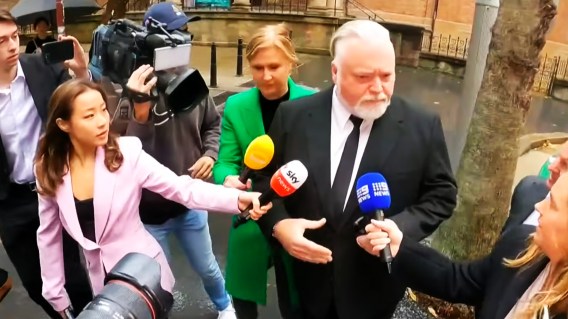
Kyle Sandilands arrives in court (Nine)
ARN Media, owner of Kiis FM and until recently the employer of Australian radio’s most expensive talent roster, currently has a market capitalisation of approximately $59m. Jackie Henderson’s lawsuit against it is seeking $82.25m; Kyle Sandilands wants at least $85m. The company is worth less than the legal claim from a single person it parted ways with.
The collapse of the Kyle and Jackie O Show — detonated on air on February 20 when Sandilands publicly eviscerated his co-host of two decades, triggering contract terminations, Federal Court proceedings, and one of the most spectacular implosions in Australian media history — is really a story about an industry that has never properly interrogated the financial logic of its most expensive decisions.
What counterfactual analysis is, and why radio has avoided it
Counterfactual analysis asks a simple but dangerous question: what would have happened if we hadn’t done the thing we did?
In policy research and economics, it’s used to evaluate the true effect of an intervention — a drug, a regulation, a government program — by constructing a plausible “what if” scenario. In business, I see it as a tool used far less often than it should be, because the answer is often uncomfortable. The counterfactual requires you to hold up your decision against an alternative reality in which you made a different one, and ask which version of you was smarter objectively.

The Australian radio industry has been resistant to this kind of thinking for a simple reason: talent deals are fun and have generally worked okay. Star presenters built audiences, audiences attracted advertisers, advertisers funded increasingly large deals, and the cycle perpetuated itself. Everyone conflated the talent with the station.
But there has always been a clean, same-market, live natural experiment running in parallel.
The cost-per-audience problem
It’s worth establishing the precise nature of the financial problem with talent deals. The issue is not simply that they are expensive. The issue is that they have been structured in a way that makes them progressively more expensive over time, with no mechanism to reflect the decay in the underlying asset they are meant to be purchasing (audiences!).
Consider the unit economics of the ARN deal. Kyle Sandilands and Jackie Henderson signed a ten-year, $200m+ contract in November 2023 — $10m each per year at minimum. We know from court filings that contra and revenue share deals push that number slightly higher than that, but let’s say, conservatively, $20m a year for both of them.
At the moment the contract was signed, the Kyle and Jackie O Show was at the peak of its ratings in Sydney. In Survey 8 of 2023 — the final survey of the year, immediately preceding the deal’s execution — the show held a 16.7 per cent breakfast share. On a conservative basis, that translates to a cost of approximately $1.2 million per breakfast share point per year.
By Survey 7 of 2024, that share had fallen to 13.1 per cent — a decline of 3.6 points in under a year, against an unchanged salary base. The same $20m now bought 13.1 points instead of 16.7. Cost per rating point had risen to $1.53m, a 27 per cent increase in twelve months, from doing nothing except getting older and continuing to be expensive. And that’s just on the share of survey — it doesn’t even cover any declines in the overall format itself.
And that calculation only covers Sydney. The $200m deal was partly predicated on the Melbourne expansion — the so-called “invasion” of Australia’s second-largest radio market, which launched in early 2024. The expansion delivered a 5 per cent audience share. Melbourne’s breakfast market is fiercely competitive, and 5 per cent represents a nothingburger in ratings. If you allocate even a modest proportion of the talent cost to the Melbourne market, the cost per rating point there is not $1.53m. It is several multiples of that, buying a rating that placed the show outside the top seven stations at breakfast.
Combined — Sydney declining, Melbourne failing — the economics of the deal deteriorated with every passing survey, while the liability on ARN’s balance sheet remained fixed. ARN’s shares fell approximately 57% between the contract signing and its termination. The company’s revenue declined 10% in 2025, EBITDA fell 23%, and metro advertising revenue dropped 16%. The talent deal did not cause all of this, but it definitely got them a lot of the way there.
A global pattern: The Howard Stern precedent
Australia’s experience with over-capitalised talent is not unique. The Americans love an overvalued talent deal too.
When Howard Stern moved to SiriusXM satellite radio in 2006, the deal was transformative. He signed for an estimated US$500m over five years — roughly $100m per year — and was credited with driving millions of subscribers to a platform that needed his name to survive. At his peak, Stern commanded an audience estimated at 20m weekly listeners across terrestrial and satellite platforms combined.
The maths at that moment: $100m/20m listeners = $5 per listener per year. An aggressive price, but potentially defensible as a subscriber acquisition mechanism.
Two decades later, Stern’s audience has declined to approximately one million listeners per broadcast — a mid-single-digit percentage of his peak reach. SiriusXM, which renewed his contract repeatedly at or near the same annual value, has watched its subscriber base erode steadily as streaming platforms consumed the audio entertainment market. In its most recent annual results, paid subscribers fell by 301,000 over the full calendar year. Stern’s cost per listener, calculated on the same basis, has risen from $5 to approximately $100 per listener per year — a twenty-fold deterioration over the life of the talent relationship. Ouch.
SiriusXM’s situation is the slow-motion version of ARN’s. A company that bet its identity on a single talent relationship, signed at peak value, with no structural mechanism for the contract to reflect the decay of the underlying audience numbers. It’s consistently renewed contracts without tying them to value delivered.
The talent porting failure: Gold 101.7 Sydney

Christian O’Connell at ARN’s recent Heard event
Christian O’Connell is, by any reasonable measure, a genuine talent success story. When he moved from the UK to Melbourne in 2018, he built Gold 104.3’s breakfast audience from relative weakness to consistent number one FM in the market — a genuine and durable achievement. Over six years, he appeared in the top spot for 27 of the last 28 surveys before his Sydney move. This is a man who demonstrably built an audience.
In 2026, ARN moved him to Sydney, networking in his Melbourne show. Survey 1 of 2026 showed Gold 101.7’s Sydney breakfast falling from 9.7 per cent to 6.1 per cent — a drop of 3.6 share points, representing 74,000 lost listeners from the cumulative audience in a single survey period. ARN’s breakfast shows in Sydney collectively lost 134,000 listeners in that survey.
The lesson is not that O’Connell lacks talent. He clearly has it. The lesson is that what he built in Melbourne was a local relationship — a decade of shared jokes, local references, listener familiarity, and emotional investment between a presenter and a specific city. That relationship does not transfer easily. The audience was attached to the experience of their morning, not to the name on a contract. When ARN moved the name, they discovered that the contract and the audience were not the same thing.
This is the structural flaw in talent deal logic at its most exposed. Publishers pay for a name, believing the name carries the audience. The audience, it turns out, was never really listening to just the name. It was listening to the context.
The counterfactual: SmoothFM
In November 2023, in the same week ARN signed Kyle and Jackie O to $200m, a radio station operating in the same Sydney metro market, selling advertising against the same agency buying teams, competing for listeners against the same morning drive competitive set, had no headline talent deal at all.
Nova Entertainment’s SmoothFM was built on a deliberate inversion of the talent model. “More music, less talk.” No shock jocks. No manufactured controversy. No polarising personalities. The breakfast show was deliberately clutter-free — consistent, calm, predictable. Agencies cited its value to advertisers in explicit terms: brand safety, no controversy risk, reliable delivery, an environment that doesn’t make CMOs nervous.
In Survey 1 of 2026, SmoothFM achieved a 13.5 per cent share in Sydney — the highest in the station’s history. It is simultaneously the number one FM station in Sydney. It has been number one FM in Melbourne across multiple surveys. Its combined weekly audience exceeds 1.9m people.
Its cost per rating point for headline talent: structurally zero.
This is not to say SmoothFM has no costs. It has programming staff, music licensing, presenters, and infrastructure like every other station. But none of those costs resemble the liability structure of a talent deal. There is no single individual whose on-air outburst or contractual dispute can destroy the product overnight. The format is the talent.
If you wanted to build a counterfactual model for ARN — to ask what Kiis FM might have looked like if those $200m had been invested in format, content infrastructure, digital distribution, and music programming — the honest answer is that it would almost certainly be worth more than $73.6m today. SmoothFM, with effectively no talent expenditure at the headline level, built a more durable, more profitable, and more advertiser-friendly product in the same market, at the same time, against the same competitive set. The experiment has been running for 14 years. The results are in.
What this means for advertisers and measurement

The author Henry Innis
Many advertisers buying radio would analyse much of it through MMMs — marketing mix models — that aggregate radio into a single channel coefficient, or at best split it by AM and FM. The average MMM model produces a blended view of radio’s contribution to sales outcomes. What it cannot see, because publisher-level breakouts almost never exist at sufficient granularity, is the difference in return between buying SmoothFM and buying Kiis FM.
This matters because the two products have fundamentally different ROI profiles. SmoothFM delivers consistent audiences in a brand-safe, calm context that research consistently links to better ad processing outcomes. The cognitive state of a listener who has spent their morning drive in a relaxed, music-forward environment is measurably different from one who has spent it processing a shock jock segment.
But the average MMM can’t see this. It sees “radio.” It produces a mediocre-looking radio coefficient — the average of a format that works and a format that is increasingly dysfunctional — and the industry uses that number to make budget allocation decisions. The measurement system is, in effect, laundering the underperformance of talent-driven radio by averaging it against the strong performance of format radio.
There is also a cost the MMM will never capture: the advertiser’s pullout risk. Brands have consistently paused Kiis FM campaigns during Sandilands’ controversy cycles. Each pause resets the adstock — the cumulative advertising momentum that builds over time — forcing the brand to rebuild from scratch when the crisis passes. This is a real cost that appears nowhere in a standard media plan or MMM output. It is the invisible tax on talent-driven adjacency.
The natural evolution of measurement in audio — toward proper publisher-level breakouts, contextual weighting, and longer time series that can detect the decay of talent-driven rating curves — will eventually make all of this transparent. When advertisers can see the SmoothFM coefficient versus the KIIS FM coefficient in their own MMM data, the talent premium will collapse. It will collapse not because of a cultural shift in the industry, but because advertisers will finally be able to see what it’s worth. It’s one of the reasons I so strongly have advocated for these breakouts across the work my own company does and why we insist on them with publishers.
Will radio make the same mistake again?
Talent deals in radio are not structured as financial instruments. They are structured as acts of institutional confidence — a publisher backing a personality at the moment of peak visibility, paying a price that capitalises past performance and projects it forward, without any contractual mechanism to reflect the reality that audience share decays, markets evolve, and the relationship between a presenter and their audience is more fragile than it appears from outside.
The Kyle and Jackie O deal is the reductio ad absurdum of this logic. A company contracted to spend $200m on two people. The company is now worth less than $60m. Both of those people are suing for more than the entire company is worth. In the same market, at the same time, a competitor built the number one FM station in Sydney’s history without a single talent deal of comparable scale.
The counterfactual has been sitting in plain sight for 14 years. The problem was never that the data didn’t exist. The problem was that nobody in a position to act on it was willing to look at it directly.
The King is dead. The question is whether the industry learns anything and starts pricing talent deals properly, or whether it simply starts looking for the next one to sink the balance sheet.
Damn this was a good analysis. Did the ad revenue for the show ever match the outgoings?
Makes so much sense it hurt. 🤷♂️