Who won the advertising Super Bowl?

The Super Bowl airs today (Australian time), a day of expensive advertising from the world’s biggest brands, live music from one of the biggest artists of our time … and there’s even a bonus football game slotted between all the action.

Give the astronomical costs — 30-second slots have hit US$10m this year, up from $8m last year — it’s no surprise a lot of brands have already rolled out their creative online, which gives us the opportunity to review it right now. But first, some quick statistics to put this into context (this is sport, after all).

During the first Super Bowl, back in 1967, a 30-second ad cost US$37,500, around $370,000 in 2026 dollars. By 1985, the cost had tipped over the half-million mark for with a 30-second ad costing $525,000 ($1.58m adjusted).

Super Bowl 29, in 1995, saw ad slots surpass $1m for the first time, and since then has increased steadily: now every three seconds of airtime costs a million. So, who made the most of the investment this year (from what we’ve see so far)? We ask the experts.

The AI ad made without AI

“The ad that caught my attention was Claude’s spot,” David Jackson, executive creative director of Apparent, tells Mumbrella, noting that celebrity endorsements and nostalgia plays were in full force with this year’s Super Bowl commercials.

“In a world of big dollar ads all pushing US products, Claude’s were a really understated way of setting itself apart from its competitors, particularly ChatGPT.

Enjoying Mumbrella? Sign up for our free daily newsletter.

“During the biggest ad spend moment of the year, where every spot is about spectacle, their ads cut through with simple moments of advice like training or speaking to your mother. They used these universal truths to land their message.”

In a piece published by Mumbrella on Friday, Mark Ritson declared Anthropic’s ad for Claude “the first piece of effective brand strategy the AI category has produced.”

As he explained, the ad adopts the “versus” positioning, defining its brand by what it opposes, rather than what it is. In this case, the tagline makes it clear: “Ads are coming to AI. But not to Claude”, referring to ChatGPT’s recent announcement that advertising is coming to its service.

Ritson noted: “Claude’s campaign positions OpenAI as venal and untrustworthy. By opposition, Claude appears more human, more honest, more aligned with users. It’s a sophisticated move that sidesteps the category sameness issue entirely. You’re no longer choosing between functionally identical AI features. Claude has moved two rungs up the benefit ladder: the consumer is now choosing whether they want technology that serves them or sells them out.”

The other versus ad

Nate Vella, head of strategy at Bench Media, tells Mumbrella his team had a big discussion last week about the Superbowl ads they had previewed. They also liked an ad that adopted the versus positioning.

“The first one that really stood out was the Pepsi ad with the polar bear,” Vella said.

“What they’ve done is a really smart way for Pepsi to use their distinct brand assets that they’ve used to cut through in the past, but make them connect with audiences today.”

In this case, it’s the Pepsi Challenge, a blind taste test first featured in the soft-drink company’s commercials in 1975.

“There’s a rising trend of large brands and advertisements exhibiting traditional assets but putting a twist or spin on them that resonates with Generation Z,” Vella continues. “But I feel Pepsi is actually pushing the boundaries of what in the past would have seemed ‘safe’, and it’s able to achieve that cultural cut-through with audiences.”

Interestingly, it was the use of its competitor’s distinct brand asset — the Coca-Cola polar bear — that caused dissent between marketers around the effectiveness of this commercial (directed by Taika Waititi).

Ehrenberg-Bass Institute’s senior marketing scientist Cathy Nguyen wrote in a Mumbrella article last week: “There are many ways to dramatise brand associations that don’t rely on activating a rival. Especially at Super Bowl scale, where the goal is long term memory building as much as short term talkability.”

Ritson compared the Claude ad favourably to Pepsi’s effort, writing: “The [Claude] campaign also avoids the classic versus trap of contagion. Unlike Pepsi’s attack ads featuring Coke’s polar bears — also lined up for this year’s big game — it doesn’t bring competitor assets to mind.”

Getting yapped about

Phil Barnes, senior creative at Connecting Plots Group, was impressed by the Fanatics Spotsbook “Bet On Kendall” ad, starring Kendall Jenner, despite “hating gambling ads more than a Kiwi hates the sight of a punctured rugby ball”.

“At least this Super Bowl ad has an idea wrapped around it,” he explains. “It’s funny. Kendall Jenner’s funny. Plus, judging by the subsequent viral exchange with one of her exes, it’s getting yapped about too.”

The ad plays on the idea of the Kardashian curse, where any athlete that dates a member of the extended Kardashian-Jenner family hits a downward trajectory in their professional careers.

“Any basketball player who dates me, kind of hits a rough patch,” Jenner says in the spot. “While the world’s been talking about it, I’ve been betting on it. How else do you think I can afford all this… modeling!?” It’s a remarkable turnaround after Jenner’s much-maligned Pepsi ad from 2017, which was accused of trivialising the Black Lives Matter movement.

As Barnes puts it, this ad kicks a goal.

“Supermodel plus huge budget plus virality. See, advertising isn’t that hard.”

Cut-through with a nasty edit

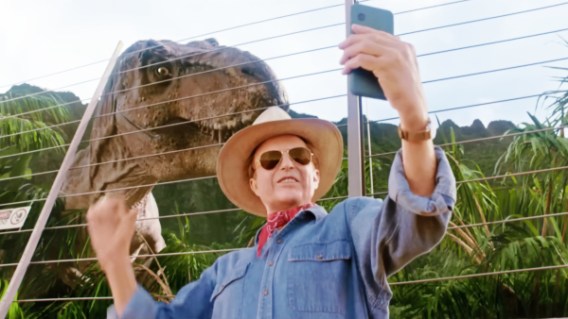
Another big pop culture referencing ad primed for virality is Xfinity’s Jurassic Park themed ad, which rather artlessly inserts new graphics and the original actors into old footage from the films.

Vella says this commercial is “really impactful in terms of the cultural cut-through”.

“This is for a business-to-business software brand, which often isn’t easy to connect on a consumer-level. They’re not ‘sexy brands’. But Xfinity has used the cultural factor of Jurassic Park in such a different way that it really reaps the rewards. It’s tapping into both the nostalgia for the film, but also making it relevant for today.”

Barnes agrees with this sentiment.

“Great fun, great writing,” he said. “Always made easier when you’re piggybacking off one of the most beloved films in cinema history — in fact, this ad’s better than the last three Jurassic Park films combined.”

Barnes even found the dodgy CGI effective, despite being “a bit Barney the Dinosaur”, as he puts it. “In a way, that adds to the nostalgia.”

Clooney wins a vote

From an effectiveness standpoint, Patrick Rowe, CEO of Saatchi and Saatchi Australia, votes for Grubhub’s ad starring George Clooney, for the line: “Eat The Fees”.

“The phrase is repeated throughout the ad and it’s perfect because it captures what the brand does, food delivery,” Rowe says.

“It helps differentiate the brand from its competitors by showing they have no added fees and lastly it uses an expression, ‘eat the fees’, that’s part of the vernacular.”

Rowe says Clooney’s inclusion is “great from a memorability standpoint” but made even better by the fact that “George Clooney as a celebrity doesn’t take over the campaign’s memorability itself. That simple phrase ‘eat the fees’ is repeated and repeated in an entertaining way so that audiences are in no doubt that this is about: people, food and fees.

“It really plays into the frequency mantra in marketing theory, that people need to hear something three times to remember it once. The repetition of this phrase captures so much to make a really effective campaign strategy.”

Hard to ignore

Sabri Suby, founder of King Kong and “shark” on Shark Tank Australia calls the Hims ad the “spiciest” of the bunch this year.

“The hook — ‘Rich people live longer’ — is bold, polarising, and impossible to ignore,” he tells Mumbrella.

“The ad villainises the wealthy, agitates the problem, and then seamlessly transitions into the call to action. With Common’s voice-over, sharp sound design, fast cuts, and a perfectly timed call to action, it’s a masterclass in attention hijacking.

“Divisive, memorable, and performance-driven — everything a Super Bowl ad should be.”

When low-brow works

Jon Skinner, founder and create partner at Core, thought the Kellogg’s Raisin Bran commercial was the most effective.

“While many brands use famous faces in the sheer hope of positive association, Kellogg’s was brave enough to take it a step further in its spot for Raisin Bran with William Shatner,” he tells Mumbrella.

The ad features Shatner as “Will Shat”, the cereal’s new Bran Ambassador, and leans on the brand’s bowel-friendly properties.

“Littered with double-entendres and sight gags, the writing is fun and will broaden the brand’s appeal,” Skinner says.

“It’s entertainment that doesn’t take itself too seriously. And even better, it’s not just another ad using famous faces, but dare I say it, famous faeces …”

Get the latest media and marketing industry news (and views) direct to your inbox.

Sign up to the free Mumbrella newsletter now.

"*" indicates required fields


SUBSCRIBE

Sign up to our free daily update to get the latest in media and marketing.